
LONDON & THE M25
Junk Removal
in Barking.
We provide collections for agreed unwanted contents in Barking, from individual furniture pieces to mixed household or business loads. Tell us the purpose of the clearance and the actual items involved, including anything stored away from the main room. We establish what can be collected, how it will leave the premises and the full price before work begins. Our team does the agreed carrying and loading. A complete enquiry helps us assess the real job without relying on a room label, a hidden bag’s appearance or an assumed amount of vehicle space.
- Carrying and loading included
- A clear quote before work begins
- Licensed and insured waste carrier

COVERAGE & CONTENTS
Barking coverage and material groups
Barking is a Greater London locality in the London Borough of Barking and Dagenham. The map marks the town for orientation and does not identify a company branch or depot. Give us the actual postcode and collection door. Ilford and Dagenham are nearby named areas, with each visit agreed for its own contents, access and availability.
Nearby collection areas: East Ham · Ilford · Forest Gate

Greater London reference outline: GLA / OS Open Data (OGL). Location: GeoNames UK gazetteer. This is an orientation map, not a service boundary or branch address.
Bring every part of the clearance into the enquiry
A change of tenancy or business handover can leave several different groups of unwanted contents. We ask for the complete list, including furniture, loose household material, equipment and any debris from repairs. A photograph of the largest piece may conceal the rest, so mention boxes behind cabinets or material in another store. Through domestic clearance, we can discuss selected rooms rather than an undefined instruction to empty everything. If furniture belongs to a landlord or another occupier, establish whether it is authorised for removal. We need the nominated person’s instructions to match the agreed scope. The result should be a collection of the specified unwanted contents, with possessions being retained or handed to somebody else kept clearly outside the list.
Home contents
Business waste
Outdoor materials
- State the purpose of the handover and the complete unwanted inventory
- Separate a cabinet from the belongings stored inside it
- Identify business stock, retained fixtures and equipment individually
- Describe sacks by material, including dense repair waste
- Include the keyholder for a rear storeroom before booking

Barking town enquiries need the precise collection address
The council publishes an Abbey and Barking Town Centre conservation-area appraisal and management plan, identifying a particular part of the town’s built environment. That local evidence is a reason to locate the actual premises, without assuming every Barking address has the same layout or status. Give us the full postcode and say whether the load belongs to a house, flat, workplace or shop. Explain which entrance serves the contents and whether the route differs from the postal frontage. This page concerns Barking locality rather than one marker for the entire administrative borough. We use the address to discuss collection access, not to imply a company branch or depot nearby. A town-centre landmark helps orientation but does not tell us the floor, entrance controls or appropriate loading position at your property.
| Contents | Information to supply | What remains separate |
|---|---|---|
| Cabinet or shelves | Whether the unit and its contents both leave | Retained documents or stock |
| Business equipment | Screens, printers and appliances named | Specialist data requirements |
| Household furniture | Pieces and rooms involved | Landlord or other occupiers’ belongings |
| Repair sacks | Materials and approximate amounts | Light packaging described separately |
Furniture and its contents are not the same removal instruction
A cabinet may be unwanted while documents inside it are staying, or loose belongings may leave while the shelving remains. Tell us that distinction explicitly. For furniture disposal, name the pieces, their locations and any size that appears close to a door or turn. Report broken glass, detached panels and unstable components before the visit. We also need to know whether an object is freestanding, fitted or already taken apart. Dismantling requests are assessed as stated work; the words furniture removal should not silently include taking joinery out of the building. Check storage units for retained belongings before they leave. We carry from the positions agreed, so there is no requirement to shift a heavy cabinet into shared space merely to make an enquiry look ready.


Business equipment, stock and fixtures are distinguished
A Barking business can describe redundant displays, spare furniture, packaging and equipment in one enquiry, while still identifying each group. Tell us which stock is unwanted and which continues to belong to the trading business. The person releasing the contents should be able to identify landlord fixtures and other occupiers’ belongings that remain. Our shop clearance and office clearance services concern the agreed removable contents. If a display is attached or a fitting needs taking out, raise that work separately. Computers, screens and printers belong on an equipment list, not inside a general description of office rubbish. Any requirement for data destruction or a certificate must be discussed in advance. Removing equipment and providing a specialist information-security service are different requirements.

We ask what is in sacks, not only how many there are
Packaging, bagged rubble and garden cuttings can occupy similar-looking containers but describe different loads. Give approximate amounts by material. For building-waste removal, identify timber, tiles, plasterboard and rubble, noting loose material and long or sharp pieces. For outdoor contents, distinguish green waste from soil, paving and old furniture. Large appliances need their type, location and connected condition explained. Any plumbing, electrical or fitted-unit work must be stated rather than inferred from collection. Tell us about chemicals, unidentified containers or anything potentially hazardous before arranging the visit; we need to confirm acceptance rather than find an unknown substance during loading. Waste removal also needs a clear boundary from pruning, landscaping or unfinished building tasks, which should be described as separate requests.
| Load type | Useful distinction | Service link |
|---|---|---|
| Household material | Loose contents versus bulky pieces | Domestic clearance |
| Freestanding furniture | Actual form, damage and size | Furniture disposal |
| Office contents | Furniture apart from electronic equipment | Office clearance |
| Outdoor material | Cuttings versus soil, paving and furniture | Garden collection |
Illustration: a shop handover with a retained display
Consider a Barking retailer leaving unwanted freestanding shelves, chairs and flattened cartons while a fitted display remains with the premises. This illustrates a possible enquiry and makes no claim about work already completed. We would ask who authorises the stock for disposal, whether the shelves are empty and where the electrical equipment, if any, is kept. A rear storeroom may require a different key and entrance from the shopfront. If bagged tiles from a minor repair are included, their amount needs stating apart from the cartons. The retained display should be excluded even when next to the unwanted shelves. With that inventory established, we can discuss removal and price. An occupier from rooms above cannot simply add household furniture without its ownership, location and carrying being included in the revised scope.

The premises route is described from the load to the vehicle
Give us the starting locations, including basements, upper floors, rear rooms and locked stores. Tell us about steps, tight corners and doors controlled by another person. A lift can help only if the actual item and building arrangement suit its use. We discuss the proposed loading position as well: public-road signs and restrictions need checking, and a private service area may depend on a manager’s entry arrangements. The council’s parking information provides the local starting reference. Customer parking or an apparently empty space should not be treated as an automatic loading agreement. Share known access conditions before booking so the quote covers realistic carrying. Appointment availability is confirmed for the job; the Barking location itself does not establish immediate arrival or a promised driving route.
From Barking enquiry to removal
01
Define the handover list
Identify unwanted contents and everything staying.
02
Explain the materials and premises
Name equipment, debris, rooms and entry controls.
03
Confirm the arrangement
Agree carrying, loading, accepted contents and complete price.
04
Remove the accepted load
We carry and load it for responsible onward handling.
| Detail | Establish | Why it matters |
|---|---|---|
| Authority | Person approving every load group | Another occupier is not included by assumption |
| Entry | Front or rear door, keys and floors | All contents can be reached as described |
| Loading | Specific road or managed-area proposal | Vehicle conditions are considered |
| Price | Full scope and later changes | The agreed cost matches the actual removal |
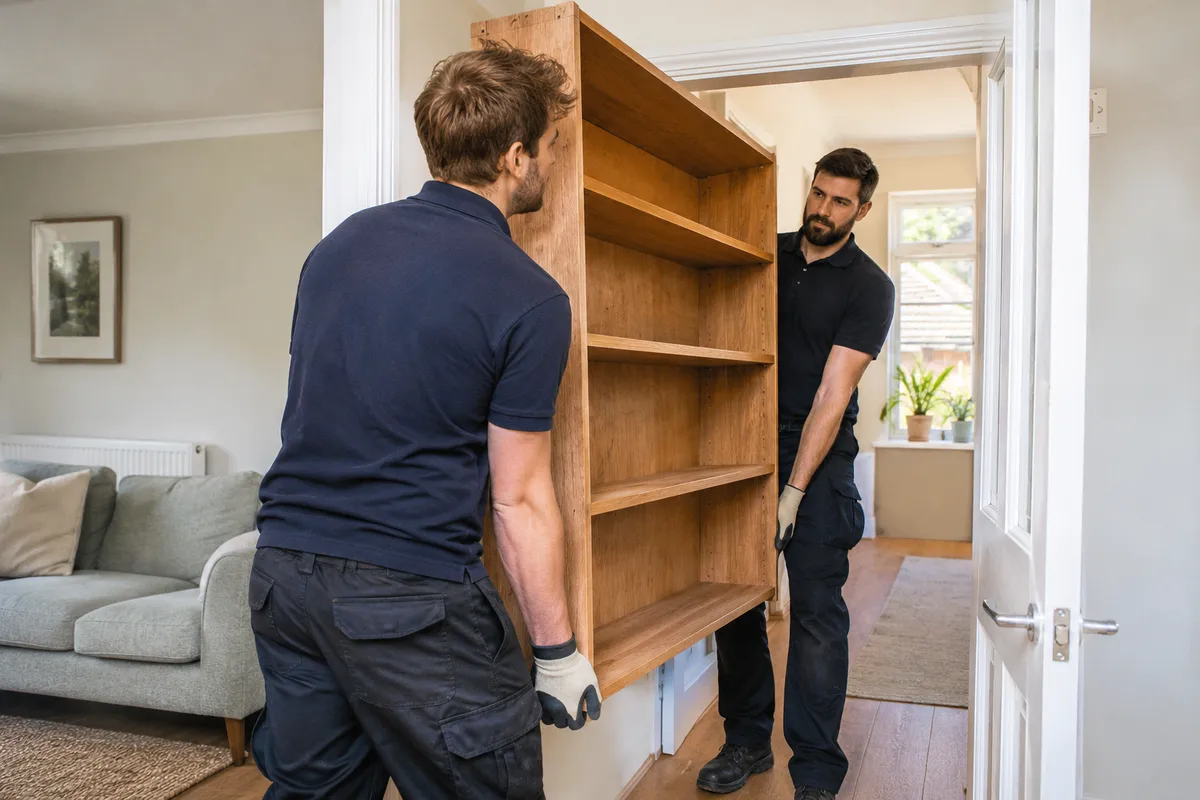
The complete quote and final removal refer to the same load
Use the current price guide for our published collection bands and relevant supplements, then ask us to confirm the full cost for your described task. The amount, materials, specific items and carrying all belong in that discussion. An appliance supplement is one possible component, not necessarily the complete price for visiting and collecting it. Tell us if another room or material group is added before work begins. We then confirm the revised scope rather than let the list expand without review. After loading, accepted waste leaves for responsible handling, with reuse and recycling pursued where possible. We give no invented local diversion figure or promise that each old fixture will find a new user. The agreed collection concerns removing unwanted contents; unrelated cleaning, repairs or installation need their own explicit discussion.
See the current collection price guide, then confirm your complete quote with us. No separate Barking tariff is implied.
More London coverage near Barking
For London and M25 collection enquiries, see the coverage directory. We publish links only to available local pages. Give us your complete postcode to discuss the property; we do not use this map as a boundary or claim a local depot.
COLLECTION QUESTIONS
Barking removal enquiries: questions answered
Can Barking shop shelves be removed while a fitted display stays?
Identify the freestanding shelves and retained display separately, including which stock or contents leave. The attending contact should know the agreed inventory. If any attached fitting is also requested for removal, describe that additional task explicitly so its scope and price are considered before the visit.
Can I remove a cabinet but keep the documents inside it?
Yes, tell us which part is unwanted and retain the belongings before the agreed furniture leaves. A cabinet and its contents are separate elements of the instruction. If someone else attends, give them the same list so stored possessions are not assumed to be included with the unit.
How do I add repair sacks to a commercial clearance?
Name the materials, approximate amounts and storage location. Rubble, tiles, timber and plasterboard need distinguishing from flattened cartons or other packaging. Explain any additional carrying route, then let us review the full scope and price before loading rather than rely on a furniture-only enquiry.
Does a shop address include household furniture from rooms above?
Only when that separate load is described and authorised. Tell us who owns the furniture, where it stands and how it reaches the exit. Sharing a postal address or entrance does not make another occupier’s belongings part of the business inventory or its original quote.
Will collecting old computers include a data destruction certificate?
Explain that requirement before booking. Our equipment-removal enquiry identifies the computers, screens and other accepted items, while specialist information-security work needs its own confirmation. Do not infer a particular destruction method or certificate solely from having the equipment included in a clearance list.
Can a rear storeroom use a different keyholder from the shopfront?
Tell us who opens each included location and whether their arrangements fit the proposed visit. We need the store’s contents and route as well as entry to the shop. A front-door key alone may not establish access to the entire agreed load, so clarify both before booking.
All generated photographs on this page are illustrative service scenes. They do not document jobs in Barking.
Discuss your Barking collection
Call +44 20 3404 3985 with the collection postcode, item list and property details. We will discuss the scope, available arrangements and quote before work begins.
Services for your Barking enquiry
Furniture disposal · Rubbish collection · House and flat clearance