
LONDON & THE M25
Junk Removal
in Croydon.
We arrange Croydon collections around the building as well as the unwanted load. A flat several floors up, an office with a managed service entrance and a house with its own front door need different practical details. Tell us what should leave, where it stands and who can provide access. Our team carries and loads the agreed contents, with the full quote discussed before work starts. The enquiry should include every room or store involved rather than assume a town-centre address or one photograph describes the whole removal.
- Carrying and loading included
- A clear quote before work begins
- Licensed and insured waste carrier

THE CARRYING ROUTE
Planning the Croydon carrying and loading
01
Identify the building
Give the postcode, entrance and access contact.
02
Confirm the inventory
Separate unwanted contents and retained belongings.
03
Discuss the route
Explain floors, lifts, stores and loading arrangements.
04
Agree the complete quote
Confirm accepted materials, extra work and availability.
05
Carry and remove
We load the agreed contents for responsible onward handling.

The building contact can be as important as the item list
For a managed block or office, explain who controls entry, lift use and any service entrance. We need to know the arrangement that applies to your collection rather than assume every visitor follows the same route. If a manager, reception team or occupier must provide access, identify that contact before booking. Tell us the actual floor and where the unwanted contents stand. A lift may be available but unsuitable for a bulky object, or its use may depend on a building arrangement. We discuss those practical details with the furniture list. Our team carries the agreed items, so placing a sofa in a shared corridor is not necessary to begin the enquiry. The plan should connect the authorised premises to the loading position without leaving access decisions for discovery after arrival.
Croydon town has contrasting building forms
The council’s tall-buildings study describes the contrast between larger commercial developments in central Croydon and the finer-grained surrounding streets, with taller buildings concentrated in the centre. We use that verified local context to ask about your particular building rather than infer access from the town name. Give the precise postcode and actual collection entrance. A postal address on a main frontage may have a separate residential or service door elsewhere. This page identifies Croydon locality, not every address in the administrative borough as one interchangeable place. We discuss the rooms, route and loading proposal for the actual property. We do not invent a local depot, standard driving route or arrival time simply because the building is near a station or prominent tower.
ADDRESS & LOADING
Flat clearances need retained contents to be identified
Through house and flat clearance, we can discuss a whole agreed load or a limited group of unwanted items. Tell us which furniture, boxes and loose contents leave and which belongings remain. A landlord appliance or dining set reserved for another person should be clearly excluded, even if it stands beside the waste. Check drawers, cupboards and shelves for possessions you intend to keep. If a representative attends, give them the same list and make sure they can provide access to every included store. We do not decide ownership from an object’s age or appearance. The collection follows an authorised instruction, with any undecided contents settled before carrying starts. Separate rooms and storage areas should be named so the quote describes the complete domestic task.
- Identify the building contact controlling entry and service access
- Give the floor and suitability of the actual furniture route
- List a separately locked store and its keyholder
- Distinguish landlord belongings and retained office fixtures
- Name equipment and repair debris beyond a general box count

| Building feature | Information needed | What it establishes |
|---|---|---|
| Entrance | Actual door, reception or entryphone arrangement | Access to the right premises |
| Vertical route | Floor, suitable lift or stairs and turns | Bulky-item carrying |
| Separate store | Location, contents and keyholder | The complete included load |
| Service access | Manager, entry control and loading proposal | Arrangement to check before booking |
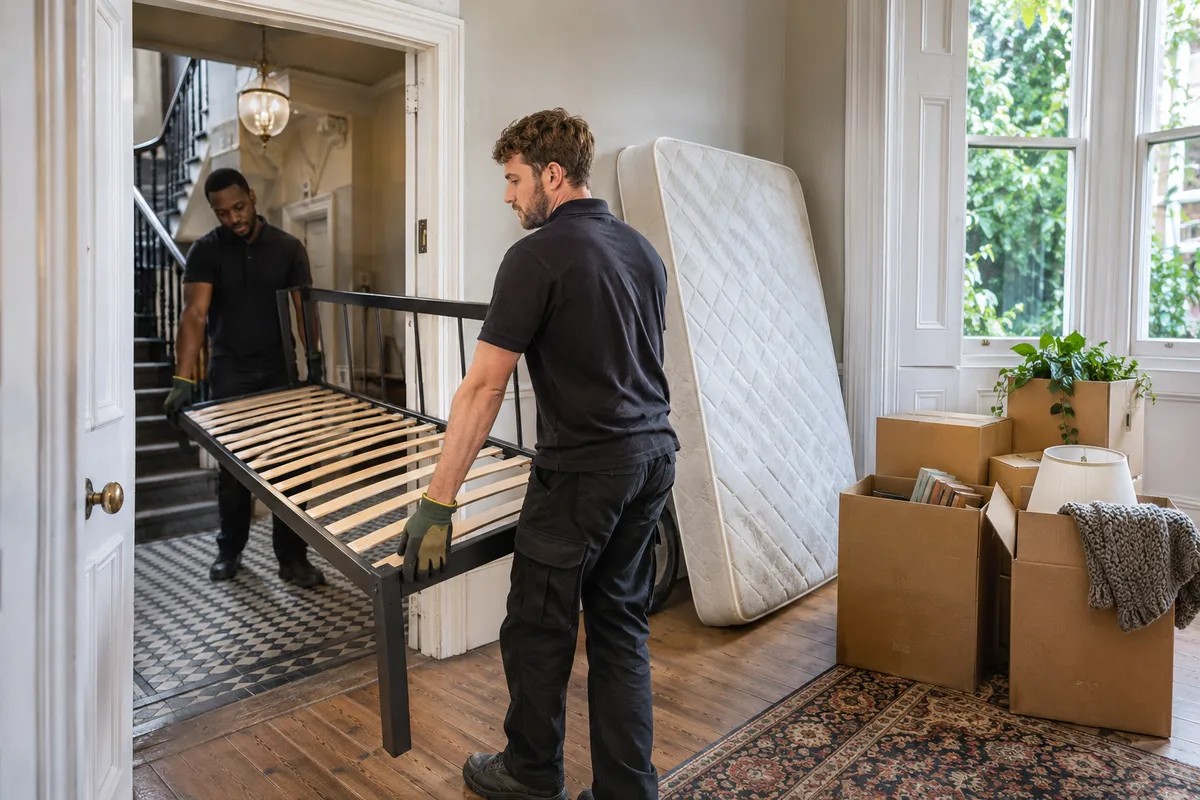
Illustration: furniture from a managed flat and a private store
Imagine a Croydon occupier replacing a sofa, mattress and small cabinet, with boxed household contents in a separately locked store. This is an illustrative enquiry rather than a claim about completed work. We would ask whether the sofa suits the lift or stair route, who opens the store and how the building’s loading entrance is arranged. The boxes should have their contents described; old monitors are not ordinary paper cartons. If a retained cabinet stands beside the unwanted one, its status belongs in the list. We can then discuss the combined load and carrying. A later addition of bagged repair rubble would need its material and approximate amount identified before relying on the initial furniture quote. The example shows why an apparently simple flat clearance needs both an inventory and access information.
Bulky furniture and appliances are described individually
Our furniture disposal service concerns the named pieces in their present condition. Give dimensions where a doorway, lift opening or stair turn looks close. Explain whether furniture is assembled, freestanding, fixed or damaged, including glass and loose panels. Requested dismantling should be agreed explicitly; removal of fitted joinery is not automatically ordinary carrying. Name appliances and electronic equipment separately, stating connected or freestanding condition for larger items. Collection does not automatically include plumbing or electrical disconnection. For electrical collection, the complete list helps identify the actual equipment and relevant handling. Business data requirements should be raised separately rather than assume collection establishes a particular destruction procedure or certificate.
| Contents | Describe | Relevant service |
|---|---|---|
| Sofa or cabinet | Size, condition and assembled form | Furniture disposal |
| Household boxes | Actual contents and approximate quantity | Domestic clearance |
| Office furniture | Authorised pieces and retained fixtures | Office clearance |
| Electrical items | Equipment type and connected condition | Electrical collection |
Office contents leave under a clear business instruction
For a Croydon office or commercial store, list desks, chairs, shelving and loose material apart from equipment. Tell us who can authorise removal and distinguish retained fixtures or another occupier’s contents. Our office clearance service can be discussed for defined items rather than an automatic full strip-out. Explain whether the route crosses a working area, whether a separate service entrance is involved and whether several floors contribute to the load. Building requirements should be raised before the visit, not assumed to be covered by the office address. Unknown containers, chemicals and suspected hazardous materials need a separate acceptance discussion. We establish the authorised contents and practical carrying, so the commercial collection has a clear scope from the enquiry through loading.


The loading proposal needs current local checks
Give us the proposed loading point and explain whether it is on a public road or within managed private access. Croydon Council’s parking restrictions information distinguishes controlled-zone, bay and street conditions. It is an official reference for local checks, with the actual signs and any private arrangement still relevant. We do not assume an empty bay, resident permit or building reception instruction settles every vehicle restriction. A rear service entrance may connect to a different road from the postal frontage, so identify it. We discuss the relationship between loading and each included location. Current appointment availability is confirmed with the job details; local coverage alone does not promise immediate removal, a loading exemption or an invented travel time.
See the current collection price guide, then confirm your complete quote with us. No separate Croydon tariff is implied.
| Point | Confirm | Avoid assuming |
|---|---|---|
| Full inventory | All rooms and stores | A first photograph shows everything |
| Extra tasks | Requested dismantling or fitted-item work | All joinery is included |
| Vehicle access | Actual restrictions and private-entry conditions | Reception access permits every loading position |
| Price and timing | Full scope and current availability | Coverage confirms immediate removal |
The complete quote includes mixed material and carrying
Our published price guide gives current bands and relevant supplements. The full quote needs the amount, material mix, specific items and work, including separate stores and requested extra tasks. Name any renovation debris such as tiles, rubble, timber or plasterboard, with approximate amounts and bagged or loose condition. Garden contents should distinguish green cuttings from soil and old furniture. Tell us about changes before loading so the scope can be reviewed. Once the accepted contents are agreed, we carry and load them for responsible removal, seeking reuse and recycling where possible. We do not guarantee reuse of every object or invent a local recycling percentage. Cleaning, repairs, installation and specialist additional requirements should be discussed explicitly rather than assumed inside a standard clearance.

LOCAL COLLECTION AREA
Where we collect in Croydon
This page identifies Croydon town within Greater London, rather than use the whole administrative borough as one locality marker. The map is for orientation and is not a depot address. Give the precise postcode and collection entrance. Purley and South Norwood are separately named areas, with availability and access discussed for each actual job.
Nearby collection areas: South Norwood · Crystal Palace · Wallington
Our London and M25 coverage is described on the Areas We Cover page. The local information here concerns the collection enquiry; it does not create a separate neighbourhood branch.

Greater London reference outline: GLA / OS Open Data (OGL). Location: GeoNames UK gazetteer. This is an orientation map, not a service boundary or branch address.
COLLECTION QUESTIONS
Croydon removal enquiries: questions answered
Can you collect from a managed Croydon apartment block?
Describe the floor, entry arrangements and suitable route for the actual items. Tell us who controls any lift or service entrance and whether separate storage is included. We discuss the practical collection around those facts rather than assume every block uses the same visitor and loading arrangement.
Does having a lift settle sofa removal from an upper floor?
We need to know whether the sofa fits the lift route and whether the building permits its use for the proposed collection. Dimensions or photographs can help with tight openings. A lift’s existence alone does not establish the whole carrying task, so describe doorways and any alternative stair route too.
Can a private store be included with the flat contents?
List it explicitly with its location, keyholder and contents. Explain whether it uses another route to the exit. A domestic collection does not automatically cover every storage space associated with a building, and the attending contact should identify only the belongings authorised for removal.
Will an office clearance include retained landlord fixtures?
Identify which fixtures remain and which contents the business may authorise for removal. A standard office collection does not automatically establish a strip-out or joinery work. Tell us about any additional task explicitly so the full quote and attending contact reflect the actual agreed scope.
Can repair rubble be added to a Croydon furniture enquiry?
Name the rubble and any tiles, timber or plasterboard separately, with approximate amounts and bagged or loose condition. We can discuss the complete load, but dense repair material should not be hidden in a household box count. Let us review the scope before loading rather than rely on the earlier furniture-only quote.
Does a building manager’s access instruction confirm street loading?
Building entry and vehicle restrictions are separate practical details to check. Give us the specific loading proposal, applicable private arrangements and actual entrance. Council information and signs at the location remain relevant; permission to enter the premises does not automatically settle every public-road or managed-yard condition.
All generated photographs on this page are illustrative service scenes. They do not document jobs in Croydon.
Discuss your Croydon collection
Call +44 20 3404 3985 with the collection postcode, item list and property details. We will discuss the scope, available arrangements and quote before work begins.
Services for your Croydon enquiry
Furniture disposal · Rubbish collection · House and flat clearance