
LONDON & THE M25
Junk Removal
in Edgware.
A flat handover needs a clear removal instruction as well as an access arrangement. We organise Edgware junk removal by establishing who can authorise the contents, which rooms contain them and how the team can carry them to a suitable loading point. The agreed furniture and rubbish are then loaded and taken away for responsible onward handling.
- Carrying and loading included
- A clear quote before work begins
- Licensed and insured waste carrier

FROM ENQUIRY TO REMOVAL
Edgware collections: the process we agree
01
Authorise the contents
Identify the exact furniture and rubbish leaving.
02
Arrange building access
Confirm keys, route and loading position.
03
Agree the collection quote
Include material types and additional work.
04
Review the handover
Check the authorised list before onward handling.

Name the person who can authorise the load
When a tenant, landlord and managing agent are all involved, the first task is to establish who can confirm the removal list. Junk Please should not be left to decide which possessions are abandoned or who owns a piece of furniture. Tell us who is instructing the collection and which contents they are authorised to remove. If keys are held by someone else, explain who will provide access and remain available for questions. A key handover alone does not settle the scope. We need the agreed furniture and loose contents identified before loading begins. Where a tenant is keeping some belongings or another contractor is collecting appliances, describe those exclusions explicitly. The collection can then proceed as a defined service rather than an assumption that an emptying flat means everything visible must go. This is particularly useful when the owner cannot attend and a representative needs to confirm the completed work.
Separate the flat inventory from the building contents
Describe the unwanted items by room, including any contents in cupboards and storage areas. A furnished flat may contain a mixture of landlord furniture and personal belongings, so the removal list needs to distinguish them. Count substantial pieces individually and describe bags or boxes by approximate quantity and general contents. A request to remove a bed should state whether the mattress is included; a request involving a desk should distinguish it from electronics or documents on top. Do not include communal property merely because it is near the flat entrance. Shared lobby furniture, building equipment and contents in a managed store require their own authorisation. If the load is already gathered in one room, explain what the photographs show and whether anything pictured is staying. An accurate list makes the quote more useful and reduces the chance of an access representative having to resolve ownership questions while the collection team waits.
Edgware crosses an administrative boundary
Harrow Council states that the Edgware Growth Area supplementary planning document was jointly adopted with Barnet. That official context matters because the locality name alone should not be used to infer the council or access arrangements for every address. Give us the full postcode and building entrance rather than only Edgware as the location. A town-centre flat, a residential house and a managed development can present different loading conditions. We do not claim that a planning document supplies current parking permission or that proposed developments are already complete. For collection planning, explain the actual driveway, service entrance or public-road loading position under consideration. Where a building manager controls access, establish their requirements for the specific premises. The official Edgware Growth Area information provides local context; the individual building and the restrictions relevant to its entrance determine the practical arrangement.
- Identify who can authorise each removal group
- Keep retained landlord furniture off the load list
- Name mattresses, appliances and refurbishment debris
- Describe the full route through communal areas
- Arrange keys and an available decision-maker
| Group | Confirm before collection | Useful detail |
|---|---|---|
| Tenant belongings | Removal is authorised | Boxes and bags described |
| Landlord furniture | Exactly which pieces leave | Retained items excluded |
| Appliances | Type and proposed work | Connections discussed separately |
| Refurbishment material | It belongs in this load | Material and quantity named |
Plan the route through the communal areas
For a flat collection, tell us the floor and whether there is a usable lift. Explain the path from the flat door to the lift, then from the building entrance to the loading position. A long corridor or an awkward turn may matter even where no stairs are involved. Bulky furniture needs dimensions and a realistic route; the presence of a lift does not prove it will fit. Tell us whether doors require a key or access control at more than one point. Someone may need to remain available rather than unlocking only the street entrance. If the building has arrangements for contractor access or use of a loading area, discuss them with the responsible person before confirming the visit. We should not assume permission to use communal land. Describe any restriction that affects the actual collection, and raise changes promptly if a lift or entrance becomes unavailable. The agreed carrying work should reflect the route the team can genuinely use.
Keep a handover load honest about materials
Furniture, bagged household contents and electrical equipment should remain distinguishable in the enquiry. Name any refrigerator, washing machine, screen or other appliance and explain its condition and location. Connection or removal work should be discussed explicitly rather than hidden within the appliance name. If refurbishment debris is present after a contractor has finished, identify it by material and approximate amount. Dense tiles or rubble differ from empty packaging and should not be described as ordinary light rubbish. Unknown containers and potentially hazardous substances need to be raised before booking so that acceptance and any specialist requirement can be discussed. We do not treat a property handover as permission to collect every material found there. The same applies to waste left outside the flat: establish who owns it and whether it forms part of the authorised collection. A clear material description supports both the quote and responsible onward handling.


| Contents | Service | Enquiry distinction |
|---|---|---|
| Flat contents | House and flat clearance | Furniture and loose waste |
| Outdoor additions | Garden waste collection | Authorised garden material |
| Project leftovers | Builders clearance | Dense debris versus packaging |
| Office furniture | Office clearance | Desks and electronics separately |
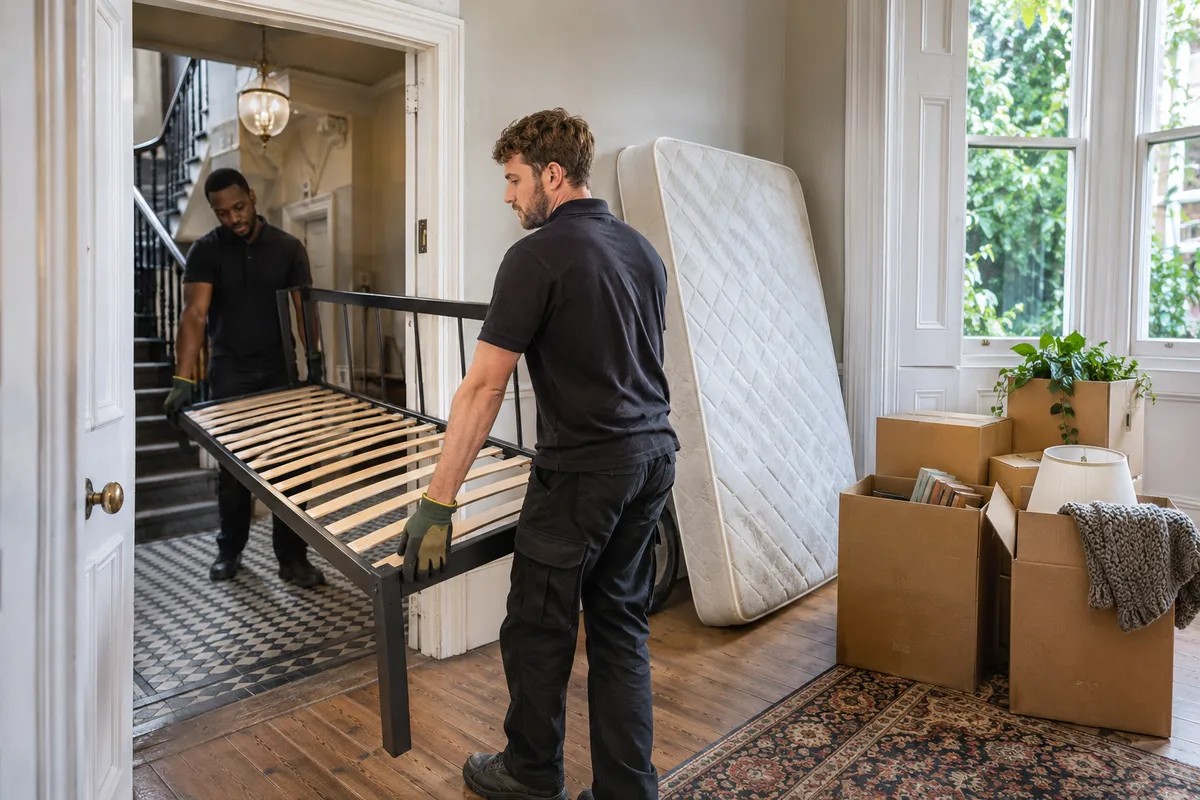
An illustrative flat-handover enquiry
Imagine an agent arranging removal from a flat after the tenant has taken the belongings they are retaining. The proposed load includes a sofa, a mattress, a dismantled bed frame and several boxes of unwanted household contents. A desk belongs to the landlord and stays. This is an example of planning, not a completed Edgware job. We would identify who can authorise the listed contents and who can attend with keys. We would ask about the floor, lift, doors and loading position, then check whether the sofa can follow that route. If an unplugged appliance is added, it needs a specific description rather than being called one more item. The retained desk would be excluded clearly. The agent can then confirm the actual load and price before work starts. The result is an organised removal instruction that fits into the wider handover without asking the collection team to decide ownership or infer building permission.
Confirm scope and timing before the key deadline
Tell us about your handover deadline when asking about availability. We can discuss a suitable arrangement, but an enquiry does not itself reserve an arrival time or guarantee same-day service. The quote needs the complete contents, material mix, access and agreed additional work. We do not invent an Edgware tariff or assume a managed building is equivalent to a ground-floor house. If the inventory changes after final inspection, update us before the visit where possible. Extra bags, an added mattress or a different carrying route may alter the original description. Likewise, tell us if another contractor removes some of the agreed furniture first. Before loading begins, the person responsible should understand the contents and price being agreed. This keeps the collection tied to the real flat handover rather than an early estimate that no longer reflects the premises. Clear communication is especially valuable when keys, ownership and timing are managed by different people.
| Access point | Question | Who should confirm |
|---|---|---|
| Flat door | Who holds keys? | Collection organiser |
| Lift and corridor | Can the items use this route? | Organiser and building contact |
| Managed entrance | Are controls or arrangements required? | Building manager |
| Loading space | Is its use authorised? | Person responsible for the premises |
See the current collection price guide, then confirm your complete quote with us. No separate Edgware tariff is implied.
Close the removal against the agreed inventory
At the end of loading, the authorised representative should check the agreed rooms and groups. Confirm that the specified unwanted furniture and rubbish have gone while retained landlord or tenant belongings remain. A flat does not need to be completely empty if the collection instruction was limited. The load leaves for responsible handling, with reuse and recycling considered where appropriate to condition and material. We do not guarantee that all furniture will be reused or claim an unsupported Edgware recycling rate. Junk removal also does not automatically include an end-of-tenancy clean, repairs or an inventory inspection for the landlord. Discuss those separate requirements clearly. If further material is discovered in a cupboard after the main load is removed, identify it and agree any change before it is added. A defined handover gives the agent or owner a clear record of the removal task and leaves the wider property process with its own responsibilities intact.
LOCAL COLLECTION AREA
Where we collect in Edgware
The map marks Edgware’s OpenStreetMap place location for orientation, not a Junk Please office. The town-centre planning context spans Barnet and Harrow, so give us the full postcode and actual building entrance rather than relying on the locality name for access planning.
Nearby collection areas: Burnt Oak · Stanmore · Queensbury
Our London and M25 coverage is described on the Areas We Cover page. The local information here concerns the collection enquiry; it does not create a separate neighbourhood branch.

Greater London reference outline: GLA / OS Open Data (OGL). Location: OpenStreetMap Nominatim. This is an orientation map, not a service boundary or branch address.
COLLECTION QUESTIONS
Edgware removal enquiries: questions answered
Can a managing agent arrange an Edgware flat collection?
Yes, provided the removal instruction and access are clear. Identify who can authorise the contents, who will provide keys and who can answer questions during the visit. We should not be asked to decide ownership of belongings.
Will you remove everything visible in an emptying flat?
Only the agreed contents. Identify retained landlord furniture, tenant belongings and anything awaiting another collection. A property handover is not automatically an instruction to empty every cupboard or remove communal items.
What building details matter beyond the floor number?
Tell us about the lift, corridors, controlled doors and the route to the loading position. Bulky furniture may need dimensions checked against that route. Discuss any building-manager arrangements for access before the visit.
Can the key holder leave after opening the building?
Someone needs to remain available to confirm the agreed scope and resolve access questions. Explain the proposed arrangement when enquiring. A single unlocked door may not provide ongoing access through a managed building.
Can refurbishment debris be collected with flat furniture?
Describe the debris separately by material and approximate amount. We discuss the complete proposed mix and any acceptance limits. Dense rubble or tiles should not be hidden within a description of light household rubbish.
Does the collection include an end-of-tenancy clean?
Carrying, loading and removal of the agreed contents should not be assumed to include cleaning, repairs or an inventory inspection. Explain any additional requirement explicitly so the scope of the junk-removal service remains clear.
All generated photographs on this page are illustrative service scenes. They do not document jobs in Edgware.
Discuss your Edgware collection
Call +44 20 3404 3985 with the collection postcode, item list and property details. We will discuss the scope, available arrangements and quote before work begins.
Services for your Edgware enquiry
Furniture disposal · Rubbish collection · House and flat clearance