
LONDON & THE M25
Junk Removal
in Enfield.
An Enfield collection starts with the actual property and contents, rather than the borough name alone. We organise removal of agreed household furniture, loose belongings and workplace items by identifying their materials and access. Our team carries and loads the specified groups after the scope and quote have been discussed.
- Carrying and loading included
- A clear quote before work begins
- Licensed and insured waste carrier

COVERAGE & CONTENTS
Enfield coverage and material groups
The map identifies Enfield Town’s verified locality position rather than a borough centroid, depot or service boundary. Give the full postcode and actual premises entrance for the collection enquiry.
Nearby collection areas: Edmonton · Tottenham · Wood Green

Greater London reference outline: GLA / OS Open Data (OGL). Location: GeoNames UK gazetteer. This is an orientation map, not a service boundary or branch address.
Enfield Town is a place within a wider borough
Enfield Council publishes a specific Enfield Town conservation-area appraisal and management material. This provides an official local reference for the town, not a description of every address across the borough. Tell Junk Please the full postcode, premises type and actual collection entrance. A home, upstairs workplace and commercial store need individual content and access descriptions. We do not infer a driveway or loading permission from a town-centre address. The official Enfield Town information supplies context rather than a special rule for loose furniture removal. Explain who controls private or shared space and where loading could take place. The map gives orientation, while the specific premises and material list establish the collection. This keeps an enquiry focused on your address without treating a borough-wide name as a substitute for practical details.
Home contents
Business waste
Outdoor materials
- Give the exact town address and entrance
- Identify furniture components and loose contents
- Describe dense boxes separately
- Settle authority for workplace equipment
- Explain outdoor materials and carrying routes

Describe the cabinet as the object that will leave
An empty cabinet can be a rigid body, a set of removable shelves or a unit that has already been taken apart. Tell us which description matches yours. Give the largest piece’s size and mention glass, loose doors or damaged joints that affect its condition. If part of the cabinet is being kept, identify that component rather than leaving the team to infer it. A request for the unit itself should be distinct from a request to remove its contents. We can discuss any preparation needed from the stated starting condition; the enquiry should not quietly assume work on fitted material. For a mixed enquiry involving a desk too, describe both objects independently. Their dimensions, rooms and ownership may differ even when one photograph makes them appear to be a single furniture group.
| Group | Describe | Service |
|---|---|---|
| Household contents | Furniture and loose belongings | House and flat clearance |
| Workplace equipment | Desks, storage and devices | Office clearance |
| Garden additions | Cuttings, objects and soil separately | Garden waste collection |
| Project leftovers | Timber, tiles and rubble | Builders clearance |
Explain what the checked household boxes contain
Use ordinary material descriptions such as books, clothing or crockery, with an approximate number or amount for each group. Private details are not needed. The important difference is that a compact box of books does not represent the same material as empty wrapping occupying similar space. Say which containers have been checked and authorised by their owners. Undecided boxes should not become part of the load simply because they stand next to the cabinet. If family collections change what remains, update this account before agreeing the removal. Photographs can establish the overall arrangement, while your explanation establishes which contents are included. Keeping this loose-content inventory separate also makes completion easier to review: the cabinet may be gone, but the boxes still need to be accounted for on their own terms.

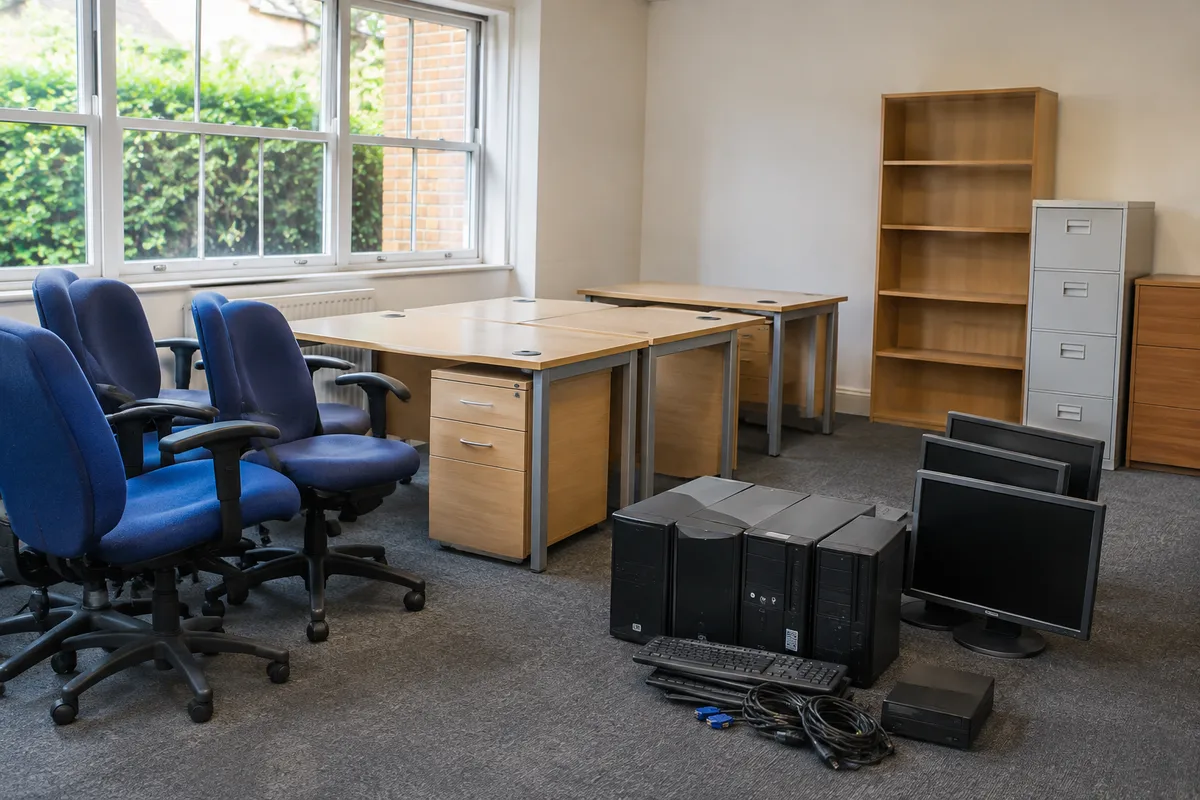
Make the desk and monitor two decisions
The desk in the example and the monitor beside it need separate authorisation. A workplace device may belong to someone other than the household furniture owner, and its location does not settle that question. Tell us which item is unwanted, what preparation is complete and what information or records the owner needs to retain. Any specialist data or document requirement should be raised expressly. The desk may have a pedestal, drawers and loose components that are not obvious from its top surface, so identify those too. Check retained papers and small belongings before the unit joins the approved load. This does not require an elaborate equipment register. It requires a clear distinction between the furniture being removed and the electronic item being considered, so neither is silently included or left behind through an ambiguous instruction.

Outdoor and project groups change the material mix
Garden furniture, cuttings, soil and paving are different groups even when gathered together. Explain approximate amounts and what containers hold. Timber may be loose offcuts, dismantled furniture or attached material; describe the actual condition and proposed work. Renovation leftovers such as tiles and rubble should be distinguished from light cartons. Confirm what another contractor has already prepared instead of assuming it will be loose before arrival. Unknown containers, chemicals and potentially hazardous substances need to be raised before booking so acceptance and specialist requirements can be discussed. Do not disturb unsafe material merely to improve an estimate. Outdoor household boxes also need a contents and condition description. We confirm the complete proposed mix and limitations before treating the groups as one collection, with retained tools and new fittings outside the instruction.
| Detail | Tell us | Why |
|---|---|---|
| Components | Panels, drawers and mattresses | Complete load |
| Contents | Books versus wrapping | Density |
| Authority | Owner of work equipment | Clear instruction |
| Access | Actual entrance and route | Real carrying |
Describe the separate journeys within one enquiry
For the illustrated load, explain the cabinet’s room, the box group’s current position and the desk’s exit. Then give the route from the garden furniture to the same or a different loading point. This prevents one convenient front-door description concealing an upstairs carry or rear gate. Show significant turns for the largest rigid item and state the lift or stair arrangement where relevant. We should know who can keep controlled doors available and who can approve use of a private approach. A place marker or apparently empty space cannot supply that authority. If preparation by another person changes the route, confirm what has actually happened. The collection discussion then connects named groups to real movement rather than assuming every approved item is already gathered at the entrance.

A fictional selected-content enquiry
Imagine an occupier arranging removal of an empty cabinet, checked household boxes and an old desk. An unplugged monitor is also unwanted, while current records, seating and another person’s boxes stay. A small garden-furniture group is proposed separately. This is a planning illustration, not a completed Enfield job. We would distinguish the material groups and authority, ask about the cabinet construction and identify the device individually. The organiser would explain the routes from the rooms and garden to loading. If dense repair debris is added, its material and amount need discussion before inclusion. A settled list allows the complete quote to be agreed before carrying. The collection then removes the authorised contents without becoming an instruction to empty every part of the premises or decide which remaining belongings should go.
From Enfield enquiry to removal
01
Identify the exact premises
Give the full postcode and entrance.
02
Separate the contents
List material groups and owners.
03
Agree route and quote
Confirm carrying and extra work.
04
Remove the authorised load
Carry, load and take away responsibly.
| Stage | Confirm | Result |
|---|---|---|
| Enquiry | All materials identified | Defined scope |
| Access | Route and permission available | Practical visit |
| Quote | Final changes included | Clear price |
| Handover | Retained and removed groups checked | Defined completion |

Use one settled account for price and completion
Once the cabinet, checked boxes, desk, monitor and any garden addition are defined, compare them with the latest situation before agreeing the charge. A piece retained after the first enquiry or a new dense-debris group needs to be reflected, not left to an outdated photograph. Raise timing needs when discussing availability and confirm the booking arrangement itself. At the visit, the contact should recognise that same account. After collection, check furniture components and loose groups separately while leaving retained records and other possessions outside the review. Onward handling follows the material and condition of what was collected; reuse and recycling are considered without claiming every object has the same outcome. Reorganising the remaining room, repairs or installation are distinct activities. A defined removal can be complete even while those later decisions are still pending.
See the current collection price guide, then confirm your complete quote with us. No separate Enfield tariff is implied.
More London coverage near Enfield
For London and M25 collection enquiries, see the coverage directory. We publish links only to available local pages. Give us your complete postcode to discuss the property; we do not use this map as a boundary or claim a local depot.
COLLECTION QUESTIONS
Enfield removal enquiries: questions answered
How do I describe a cabinet already taken apart?
Identify the largest panel, doors, shelves and other components leaving, with their current locations. Say if any part is retained. This is clearer than assuming the original cabinet name explains the loose group.
What information is needed about checked boxes?
Give general materials and approximate quantities, not private personal details. Distinguish dense books or crockery from wrapping and state which owners have authorised the contents.
Can the desk leave while its monitor stays?
Yes. Make those separate decisions explicit, including the status of any pedestal or drawers. Equipment beside unwanted furniture is not automatically included.
What if an employer owns the device?
Settle the relevant permission and retention decisions before approving it for removal. Tell us about specialist requirements directly rather than assuming the device’s location establishes authority or service scope.
Can the garden addition use a different route?
Describe it independently, including the gate, carry and authorised loading arrangement. One enquiry can contain several journeys; they should not be reduced to the cabinet’s front-door route.
When is a selective collection complete?
Compare the removed components and loose groups with the final authorised account. Retained belongings can remain deliberately, and later repairs or room organisation should not change the defined removal endpoint.
All generated photographs on this page are illustrative service scenes. They do not document jobs in Enfield.
Discuss your Enfield collection
Call +44 20 3404 3985 with the collection postcode, item list and property details. We will discuss the scope, available arrangements and quote before work begins.
Services for your Enfield enquiry
Furniture disposal · Rubbish collection · House and flat clearance