
LONDON & THE M25
Junk Removal
in Greenford.
A garden workshop can contain useful tools, loose project material and furniture that is no longer wanted. We organise Greenford junk removal by separating those decisions and identifying the route from the workshop to loading. We agree the contents and work, then carry and load the specified groups for responsible onward handling.
- Carrying and loading included
- A clear quote before work begins
- Licensed and insured waste carrier

FROM ENQUIRY TO REMOVAL
Greenford collections: the process we agree
01
Define unwanted contents
Separate retained tools and fittings.
02
Describe material groups
Identify timber, objects and hard debris.
03
Agree route and quote
Confirm access and extra work.
04
Review the workshop
Check the list before onward handling.

Choose the workshop contents that leave
Tell Junk Please which objects and material groups are unwanted rather than describing the whole workshop as rubbish. Tools still in use, spare parts and personal belongings may stand beside broken seating or old timber. Settle those decisions before booking and nominate someone who can confirm the list at the property. We do not judge an object’s usefulness from age or appearance. Count substantial furniture individually and describe loose contents by approximate amount and general type. If another person owns equipment stored there, obtain their authority before including it. A workshop location helps organise the enquiry but does not establish the material mix or permission to remove everything inside. The collection should follow a defined inventory, leaving retained tools and any undecided groups outside the instruction. This makes the final quote and handover easier to understand.
Distinguish loose timber from attached work surfaces
Timber can mean offcuts, dismantled furniture, freestanding storage or a bench fixed to the building. State which applies. Collecting loose material is different from dismantling attached fittings or altering the structure. Discuss any proposed additional work explicitly rather than assuming workshop clearance includes it. Give useful dimensions and condition details for large pieces, including damaged or loose components. If furniture is already dismantled, identify the panels and fittings leaving. Keep retained parts separate. Do not begin taking apart a unit if that would leave it unstable merely to prepare for collection. Check drawers and cupboards for personal records, keys and tools. We do not decide which contents should remain. A precise construction and contents description gives the quote a clearer basis than a photograph of timber that does not show whether it is fixed or loose.
Greenford context does not provide workshop access
Ealing Council identifies Ravenor Park near central Greenford and publishes its entrances, including Oldfield Road South. It is a useful official local reference, but public park access is not permission to reach a private workshop. Give us the complete postcode and actual entrance serving your property. A rear store may use a side passage, shared drive or route through the house. Explain which is available and who can authorise it. We do not assume a shortcut across neighbouring land or public green space because it looks direct on a map. The official Ravenor Park information supplies context rather than loading authority. Current restrictions and permission at the proposed collection position need their own consideration. Raise uncertain access before booking instead of presenting it as an established route.
- Identify useful tools before the removal list
- Separate loose timber from attached benches
- Name paving, soil and cuttings individually
- Describe the garden-to-loading route
- Raise unknown containers before booking

| Group | Describe | Retain explicitly |
|---|---|---|
| Timber | Loose or fixed material | Attached bench |
| Furniture | Size and components | Usable storage |
| Tools | Authority and equipment type | Working items |
| Hard debris | Material and amount | Separate from cuttings |
Use the gate opening to test the workshop plan
For this type of collection, the awkward object is often a worktable or tall storage carcass rather than the pile of offcuts. Describe its widest rigid part and the opening it must pass through. A gate that admits a person carrying a box may still prevent a table top being turned. Include the space immediately before and after the gate, not just its width. Explain whether the proposed exit passes beside plants or retained equipment that cannot be moved. We use those details to discuss the carry and any agreed preparation. The workshop door and garden exit may impose different limits, so a photograph of only one can miss the difficulty. If the table is already in pieces, show the largest panel. That gives the enquiry a useful physical reference without requiring you to test an unsafe lift yourself.
Describe the offcuts as a separate workshop output
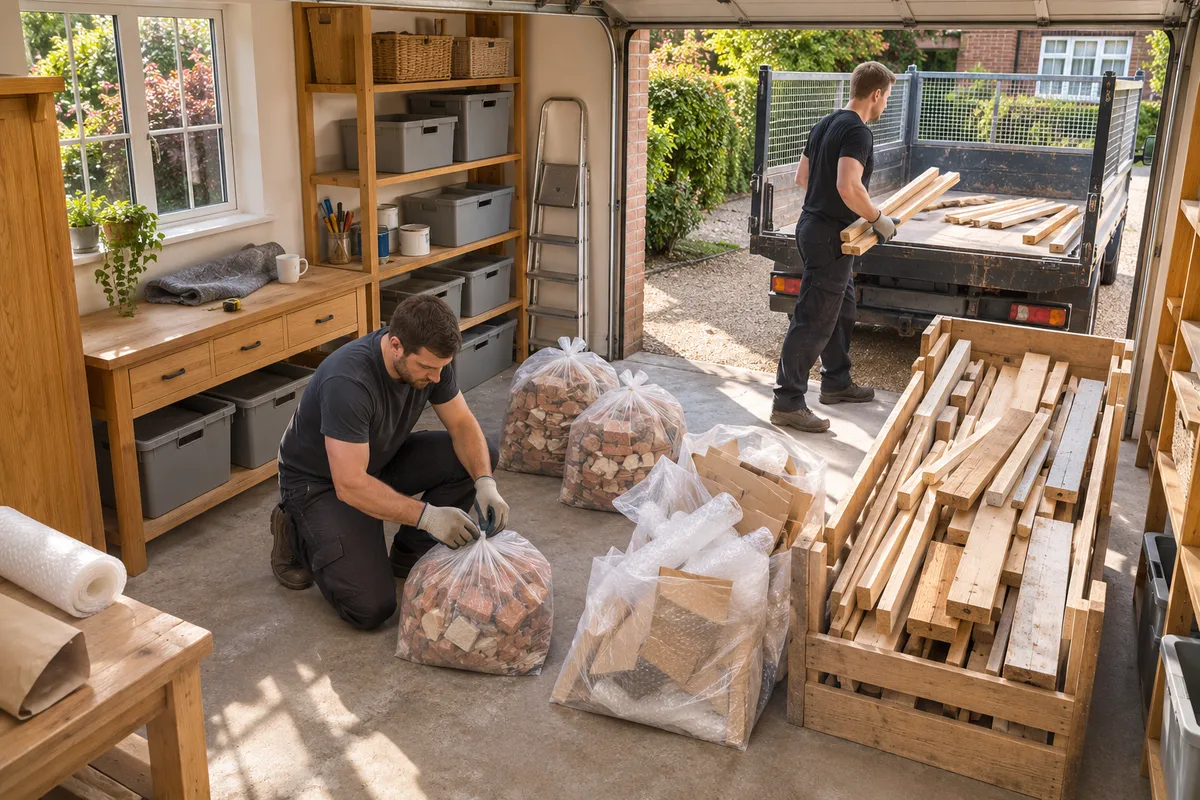
Tell us what the loose timber actually consists of: short offcuts, long boards, furniture panels or pieces with other material attached. A wide panel can create a carrying problem even where the overall amount is modest. Keep the paving quantity distinct so its density is visible in the enquiry. For electrical tools that are no longer wanted, identify the individual devices; do not bury them under a timber description. Your working tools and reusable spare parts should have an unmistakable keep group. If old tins are present, report their existence and any information you already know rather than tipping their contents out or mixing them with the offcuts. We can consider the proposed materials with that uncertainty explicit. The useful result is a description of several workshop outputs, each with its own quantity and condition, rather than a single photograph labelled shed rubbish.

| Contents | Service | Detail |
|---|---|---|
| Project material | Builders clearance | Density and quantity |
| Garden additions | Garden waste collection | Actual material type |
| Stored belongings | House and flat clearance | Furniture and contents |
| Work equipment | Office clearance | Devices and ownership |

A fictional garden-workshop reset
Imagine a household reclaiming a workshop for tools it still uses. The unwanted groups include loose timber offcuts, a broken outdoor chair and empty storage furniture. Tools, an attached bench and usable spare parts stay. A small pile of paving is also proposed as a separate group. This is an illustrative planning example, not a completed Greenford job. We would ask about timber quantity and the chair components, then distinguish the dense paving from the other contents. The attached bench would be excluded unless additional work is discussed. We would establish the route through the garden gate and who can confirm the list. If old containers are discovered, their contents need an acceptance discussion before addition. The household can then agree the final collection and price, with its next workshop project remaining separate from removal.
Price the removal after choosing the workshop keep group
The decision to retain a bench or a set of spare boards should be reflected in the collection description before the price is agreed. Otherwise the photographs may suggest more material or different work than you intend. Send a final view of the loose timber and furniture that remain for us, with the paving stated independently. Explain any preparation completed since the first enquiry, such as a freestanding table already separated into legs and top. We then discuss the removal actually required. If someone offers to take the chair before the visit, tell us whether that has happened, rather than leaving its status uncertain. Timing can be discussed alongside these details, with an appointment confirmed through the booking arrangement. The important commercial reference is the agreed workshop list and carry, not the dimensions of the outbuilding or the number of sacks alone.
| Point | Confirm | Purpose |
|---|---|---|
| Authority | Owners have decided | Clear scope |
| Construction | Loose versus attached | Agreed work |
| Access | Gate and path available | Actual route |
| Quote | Final materials included | Current price discussion |
See the current collection price guide, then confirm your complete quote with us. No separate Greenford tariff is implied.
Check the workshop by its remaining working equipment
At the end, use the retained bench and tool area as reference points. Have the loose boards beside them gone as agreed? Are all parts of the unwanted chair included? Has the separately described paving been collected? This is a more reliable check than asking whether the workshop looks empty, since useful equipment is meant to remain. Identify any overlooked component before treating the collection as finished. Material taken away is handled according to what it is and its condition; usable objects, timber and hard debris should not be presented as if they share an identical destination. We describe reuse and recycling as aims rather than guarantees for each object. The next woodworking project, fitting a new bench or repairing the store is a separate activity. A precise removal check leaves that future work with a clear starting point.

LOCAL COLLECTION AREA
Where we collect in Greenford
The map identifies Greenford’s verified place location for orientation, not a depot or loading point. Give the full postcode and actual workshop entrance. Nearby public open space supplies local context rather than collection access.
Nearby collection areas: Hanwell · Northolt · Southall
Our London and M25 coverage is described on the Areas We Cover page. The local information here concerns the collection enquiry; it does not create a separate neighbourhood branch.

Greater London reference outline: GLA / OS Open Data (OGL). Location: GeoNames UK gazetteer. This is an orientation map, not a service boundary or branch address.
COLLECTION QUESTIONS
Greenford removal enquiries: questions answered
How should I describe a worktable that may not fit the gate?
Give the size of its largest rigid part and show the turning space on both sides of the opening. Say whether it is intact or already separated. Discuss preparation before attempting to move it.
What makes offcuts different from dismantled furniture?
Describe the pieces rather than choosing one broad wood label. Long boards, broad panels and chair components create different carrying questions. Tell us about any other material still attached.
Can usable boards remain beside the waste timber?
Create a clearly identified keep group and explain it to the person attending. The collection list should specify the unwanted timber; appearance alone should never determine which boards leave.
Why name the paving separately?
Its amount and density are not explained by the timber photograph. Give a separate estimate and location so the proposed collection includes the hard material explicitly.
Should I empty old workshop tins to prepare them?
Report them and explain what you already know. Do not tip out or combine unknown contents. Acceptance needs to be discussed with the uncertainty visible in the enquiry.
How do I check completion when the workshop stays furnished?
Review the unwanted groups rather than the room’s emptiness: offcuts, chair parts and any agreed hard debris. Confirm the working tools and retained bench remain where intended.
All generated photographs on this page are illustrative service scenes. They do not document jobs in Greenford.
Discuss your Greenford collection
Call +44 20 3404 3985 with the collection postcode, item list and property details. We will discuss the scope, available arrangements and quote before work begins.
Services for your Greenford enquiry
Furniture disposal · Rubbish collection · House and flat clearance