
LONDON & THE M25
Junk Removal
in Hanger Lane.
Our Hanger Lane service brings the contents and the premises into the same collection discussion. We identify the furniture, loose waste and equipment leaving, then agree how those items can be carried from the building and loaded.
- Carrying and loading included
- A clear quote before work begins
- Licensed and insured waste carrier

SPACES, ITEMS AND MATERIALS
Clearance services for Hanger Lane properties
The premises address matters more than the road label
Hanger Lane enquiries can concern a household, an upper-floor flat or business contents. Tell us the complete address and which part of the premises contains the load. A road name or nearby landmark does not identify the entrance, the floor or a loading arrangement. We ask for those details alongside the item list so the collection is described as a practical task. If you are replacing furniture, list the pieces leaving. If you are clearing storage, add the loose contents that may not be obvious in photographs. A business enquiry should identify unwanted equipment separately from working stock. We agree the scope with the person responsible for the contents rather than infer permission from where an item happens to stand. This gives us a useful basis for discussing carrying, loading and the complete quote before a visit is arranged.
- Give the full premises address and the entrance serving the waste
- Describe flat access beyond simply naming the floor
- Separate loose filing or cupboard contents from the units
- Name redundant electronics and any connected appliances
- Discuss the actual loading point without assuming frontage access

Generated service illustrations show typical collection tasks, not documented local jobs.
| Premises | List the unwanted contents | Explain the boundary |
|---|---|---|
| Upper flat | Sofa, bed, mattress and boxed belongings | Items staying and route through the building |
| Home workroom | Desk, storage, loose contents and electronics | Retained documents and working equipment |
| Commercial room | Movable furniture and packaging | Fixed fittings outside ordinary collection |
| Outdoor storage | Cuttings, timber and dense material | Acceptance and carrying route |
Flat furniture needs a route through the building
For a Hanger Lane flat, describe how the pieces move from the room to the entrance. Tell us about the floor, stairs or usable lift, then add any narrow hallway, turn or doorway relevant to large furniture. If a building contact controls access, explain that arrangement. We do not assume that a lift is suitable for every object or that a shared entrance can be left available without agreement. Our furniture disposal service starts with the pieces themselves: size, assembled condition and whether they are freestanding. Mention dismantling if it may be needed. Mattresses should be named separately from bed frames, with the quantity clear. We discuss these requirements as part of the collection rather than treat them as surprises after a general price has been mentioned. Selected pieces can be removed without assuming the rest of the flat is being emptied.
A junction setting does not establish frontage access
Transport for London identifies the A40 and A406 in the Hanger Lane area, and council planning material records a mixture of nearby commercial and residential premises. For our service, that setting is a reason to establish your actual access rather than claim a universal loading solution. Tell us which entrance serves the rooms and where the vehicle could load. We do not promise to stop on a main-road frontage or use an unverified service route. Ealing’s published parking guidance distinguishes bay purposes and loading restrictions, with signs and kerb markings relevant to the exact position. If the premises have a private forecourt, explain who controls it; its existence does not itself give collection access. We discuss the route from the contents to a practical loading point without inventing a journey time or presenting traffic conditions as predictable.

Loose belongings are part of the load, not part of the furniture
A cabinet, wardrobe or desk can contain a second group of material that needs describing. Tell us whether the unit will be empty, whether its contents leave while the furniture stays, or whether both are included. Our house and flat clearance service can handle an agreed mixture of bulky and loose contents, but the enquiry needs the full amount. Describe boxes and sacks by approximate quantity and contents, particularly where books, electrical items or dense material are involved. If photographs show only the visible face of a stack, mention the material hidden behind it. Retained belongings, documents and keys should be kept distinct from the removal list. Someone at the visit should be able to confirm those decisions. We do not ask the team to decide which personal possessions might still be useful to you.

Office and commercial rooms need an equipment boundary
A workplace collection may include redundant desks, seating, cabinets, freestanding shelves and packaging. Explain which items are ready to leave and which must remain in service. Through our office clearance enquiry, we establish the spaces involved and the building access contact. Electrical equipment should be named separately, with its position and condition clear. If equipment contains information, raise your security requirements as a separate matter; ordinary waste collection is not certified data destruction. Likewise, a fixed installation or connected appliance should not be described as ready-to-carry furniture. We discuss any disconnection, dismantling or specialist requirement explicitly rather than imply it is automatically included. A manager or nominated representative can help keep the removal list separate from working equipment and retained stock, particularly where waste shares a room with active business contents.

Outdoor and refurbishment waste still requires material detail
Where an enquiry includes garden or renovation material, name the groups instead of counting only bags. Green cuttings and branches should be distinguished from soil, rubble, paving, timber and garden furniture. Explain the position of the waste and any gate or passage used to remove it. The garden waste service discussion is about the actual contents, not a promise to clear every substance found outdoors. For builders clearance, identify timber, plasterboard and dense debris separately enough to establish the proposed load. Tell us about unidentified containers or potentially hazardous materials before booking. We confirm acceptance rather than rely on the team to discover an unknown substance while lifting sacks. Gardening, demolition and work on fixed parts of the property should be raised separately from collection of loose waste.
Choose the right collection for Hanger Lane
| Description | Add this detail | Why it helps |
|---|---|---|
| One desk | Empty or contents also leaving | Defines the loose load |
| Several sacks | Material inside and approximate quantity | Avoids hiding dense or unsuitable contents |
| A large sofa | Room, dimensions and exit route | Defines bulky carrying |
| Old appliance | Name and connection status | Clarifies the proposed collection work |

An illustrative flat collection with a separate workroom load
Consider a Hanger Lane resident replacing a sofa and clearing boxes from a home workroom. This is an example of how we would discuss an enquiry, not a completed local collection. We would record the sofa’s location and dimensions, the route through the building and the contents of the boxes. If a redundant computer or monitor is included, it needs its own description, with any information-security requirement raised separately. If a filing cabinet stays but its loose contents leave, that boundary belongs in the list. We would also discuss the actual loading point instead of assume the vehicle can stop at the nearest frontage. A later-added mattress changes the agreed contents and should be reported before collection. The result is a clear combined enquiry in which several groups can be considered together without treating the original quote as unlimited removal from the whole property.
| Point | What to tell us | What we discuss |
|---|---|---|
| Building entrance | Correct door, gate and contact | How the team reaches the load |
| Internal route | Lift, stairs, narrow turns or corridors | Movement of the agreed pieces |
| Vehicle position | Possible loading location | Practical carrying and restrictions |
| Changed conditions | New access instructions or added contents | Updated scope and complete price |
The collection price and the onward handling follow the contents
Refer to our current price guide, then discuss the amount, materials, carrying and any additional agreed work for your Hanger Lane enquiry. Named appliances, mattresses and dense debris help make relevant supplements clear. We do not invent a road-specific tariff or promise a price based only on a room count. Tell us about a changed load or access arrangement before the visit where possible so the full quote can be confirmed before work begins. Availability, including requests at short notice, is discussed directly. After carrying and loading the agreed items, we take the waste away for responsible handling, seeking reuse and recycling wherever possible. Suitability depends on condition and composition; we do not guarantee that every object is reusable or assign an unsupported recovery percentage to the job. The defined service is removal of the agreed contents, with any further property work requiring its own discussion.
See the current collection price guide, then confirm your complete quote with us. No separate Hanger Lane tariff is implied.

Hanger Lane: from item list to removal
01
Locate the contents
Identify the rooms, floor and correct entrance.
02
Name the load
Separate furniture, loose belongings and equipment.
03
Agree the practical visit
Discuss loading, carrying, price and availability.
04
Carry and take away
We remove the agreed contents for responsible handling.
LOCAL COLLECTION AREA
Where we collect in Hanger Lane
We discuss Hanger Lane collections using the exact postcode and premises access information. The map marker identifies the locality for orientation; it is not a depot or a claim of access to any road frontage. Confirm your entrance and contents directly with us.
Nearby collection areas: Park Royal · Alperton · Perivale
Our London and M25 coverage is described on the Areas We Cover page. The local information here concerns the collection enquiry; it does not create a separate neighbourhood branch.
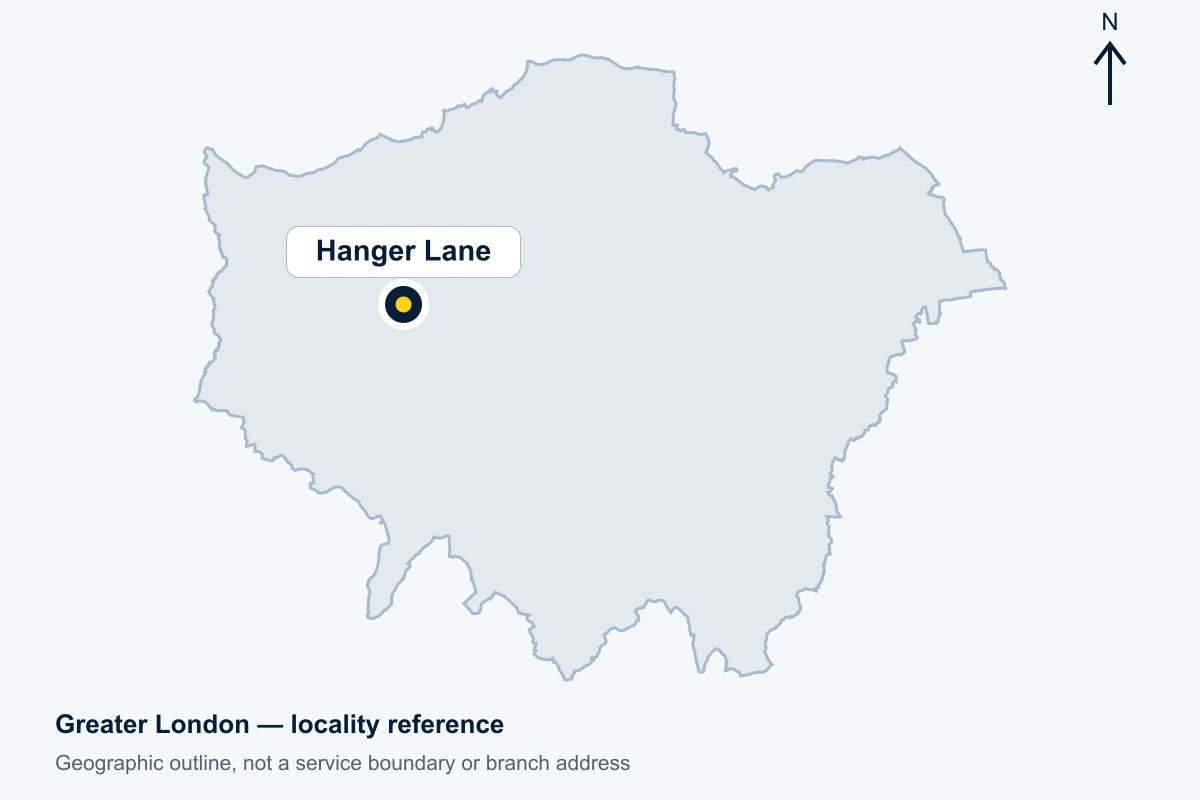
Greater London reference outline: GLA / OS Open Data (OGL). Location: Transport for London. The point uses Hanger Lane Underground Station as a local reference. This is an orientation map, not a service boundary or branch address.
COLLECTION QUESTIONS
Hanger Lane removal enquiries: questions answered
Why is the full address needed for a Hanger Lane enquiry?
The road name does not establish which premises, entrance or floor contains the waste. Give the full postcode and explain the route to the proposed loading point. Those details let us discuss the actual collection rather than assume a standard arrangement for every address in the area.
Can you collect a sofa from a flat with a shared corridor?
Describe the sofa and the route through the corridor, stairs or usable lift, including any tight turn. Explain who controls building access. We discuss the carrying and any additional requirements before booking rather than assume all bulky furniture can use the same route without assessment.
Can the van simply stop on the main-road frontage?
We discuss the actual loading position and relevant restrictions for the address. A nearby main road does not establish permission to stop there, and a private area needs its own access arrangement. Tell us the possible position so carrying and loading can be considered realistically.
How do I include a filing cabinet without discarding its papers?
State that the cabinet leaves but its documents remain, and arrange for retained contents to be separated beforehand. If papers are also unwanted, describe them as a separate group and raise any security requirement explicitly. Ordinary collection is not an implied certified information-destruction service.
Do old monitors count as ordinary boxes in the quote?
Name the monitors and other electrical equipment individually instead of grouping them under boxes. Tell us their quantity and location. This allows the proposed electronic waste collection, relevant handling and full price to be discussed before they are included in the load.
Can additional sacks be included when the team arrives?
Tell us about extra contents before the visit where possible, including what the sacks contain. The original quote covers the agreed amount and work. Any added material needs to be discussed and accepted, with the complete price clear before it is treated as part of the collection.
All generated photographs on this page are illustrative service scenes. They do not document jobs in Hanger Lane.
Discuss your Hanger Lane collection
Call +44 20 3404 3985 with the collection postcode, item list and property details. We will discuss the scope, available arrangements and quote before work begins.
Services for your Hanger Lane enquiry
Furniture disposal · Rubbish collection · House and flat clearance