
LONDON & THE M25
Junk Removal
in Hayes.
A workplace can contain redundant business furniture alongside personal belongings stored there temporarily. We organise Hayes junk removal by keeping those groups and their authorisations clear. We discuss the material mix and actual entrance, agree the collection, then carry and load the specified contents for responsible onward handling.
- Carrying and loading included
- A clear quote before work begins
- Licensed and insured waste carrier

FROM ENQUIRY TO REMOVAL
Hayes collections: the process we agree
01
Identify ownership groups
Settle authority for each load.
02
Describe contents and access
Include containers and service entrance.
03
Agree the complete quote
Confirm additional work and changes.
04
Review both instructions
Check retained and removed groups.
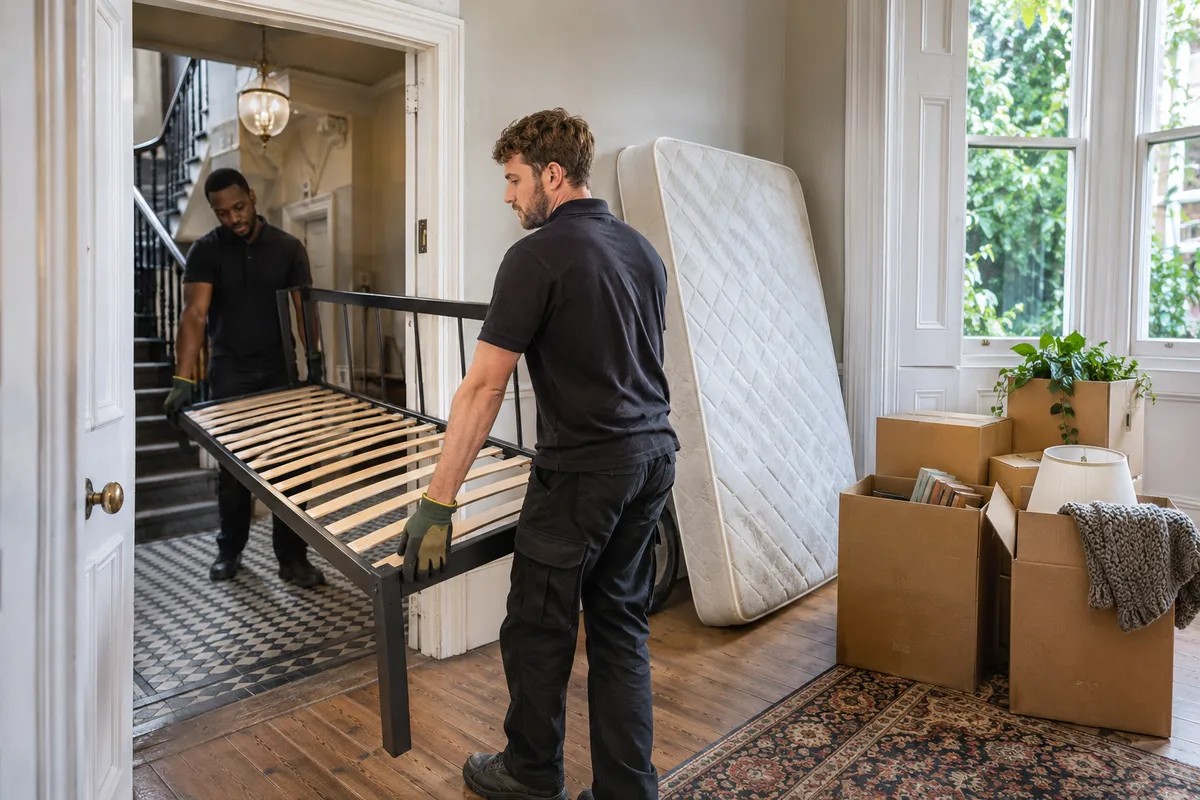
Establish two clear instructions if ownership differs
Tell Junk Please which contents belong to the business and which are private belongings. Their presence at the same address does not give one person authority over both. The organiser should settle permission for every group before booking and nominate someone who can confirm the agreed list. A business desk, landlord cabinet and household boxes may have different owners and destinations. Identify retained pieces explicitly. We do not decide that equipment is obsolete or personal possessions abandoned. List substantial furniture individually and describe loose contents by general type and approximate quantity. If a colleague or relative is collecting part of the group first, explain what will remain for us. A defined instruction keeps the collection manageable while protecting decisions that belong to the owners. It also prevents a key holder being asked to resolve ownership once loading is ready to begin.
Describe the furniture without assuming the contents
A worktable or storage cabinet can be empty, contain unwanted material or hold belongings still in use. State which applies. Removing the cabinet does not automatically include every object inside it, and clearing contents does not automatically mean the unit goes too. Check drawers for business records, keys and personal items before furniture joins the load. We do not provide a retention decision or assume general junk removal includes confidential destruction. Raise any specialist need explicitly. Explain whether storage is freestanding, already dismantled or attached to the building. Any dismantling or removal of fittings needs discussion rather than being hidden within furniture collection. Identify loose panels and separate pedestals where relevant. A clear description supports the quote and gives the representative a practical way to check the components at handover.
Hayes context needs the exact premises
Hillingdon Council identifies Central Avenue in Hayes among its areas of special local character. This is an official example of specific local property context, not a description of every workplace or home across Hayes. Give the complete postcode and actual collection entrance. A business frontage may differ from its rear service access, especially where personal contents are stored away from the main work area. Explain gates, shared yards and who controls them. We do not infer loading authority from an open commercial entrance or empty space. The official local-character information supplies context rather than current permission for a vehicle. The premises arrangement and relevant restrictions at the proposed position need individual consideration. Do not assume a locality name establishes one route or one type of building.
- Separate business and private authorisations
- Check cabinet contents and retained records
- Identify containers by contents rather than appearance
- Describe the actual service entrance
- Review ownership groups separately at handover

| Group | Authority to settle | Description |
|---|---|---|
| Business furniture | Business representative | Pieces and components |
| Personal boxes | Owner or authorised person | General contents and amount |
| Landlord fittings | Premises owner | Retain unless explicitly authorised |
| Containers | Responsible owner | Contents or uncertainty |
Plan the route through an operating workplace
Tell us where each group stands and whether staff, customers or other contractors will use the route. Household boxes in an upper store and desks near a ground-floor exit involve different carries. Describe stairs, lifts, corridors, controlled doors and the path to loading. Bulky furniture needs dimensions and a condition description. Discuss any dismantling explicitly, including whether another contractor is expected to prepare it. We should not assume that work has happened until it is confirmed. Keep retained stock and equipment clear of the route where practical without unsafe moves. Someone may need to remain present to unlock gates and answer questions throughout the visit. The quote should reflect the actual current locations and route. If the entrance or stored contents move before collection, update us so the arrangement stays connected to the work genuinely available.
Do not let containers conceal a different material
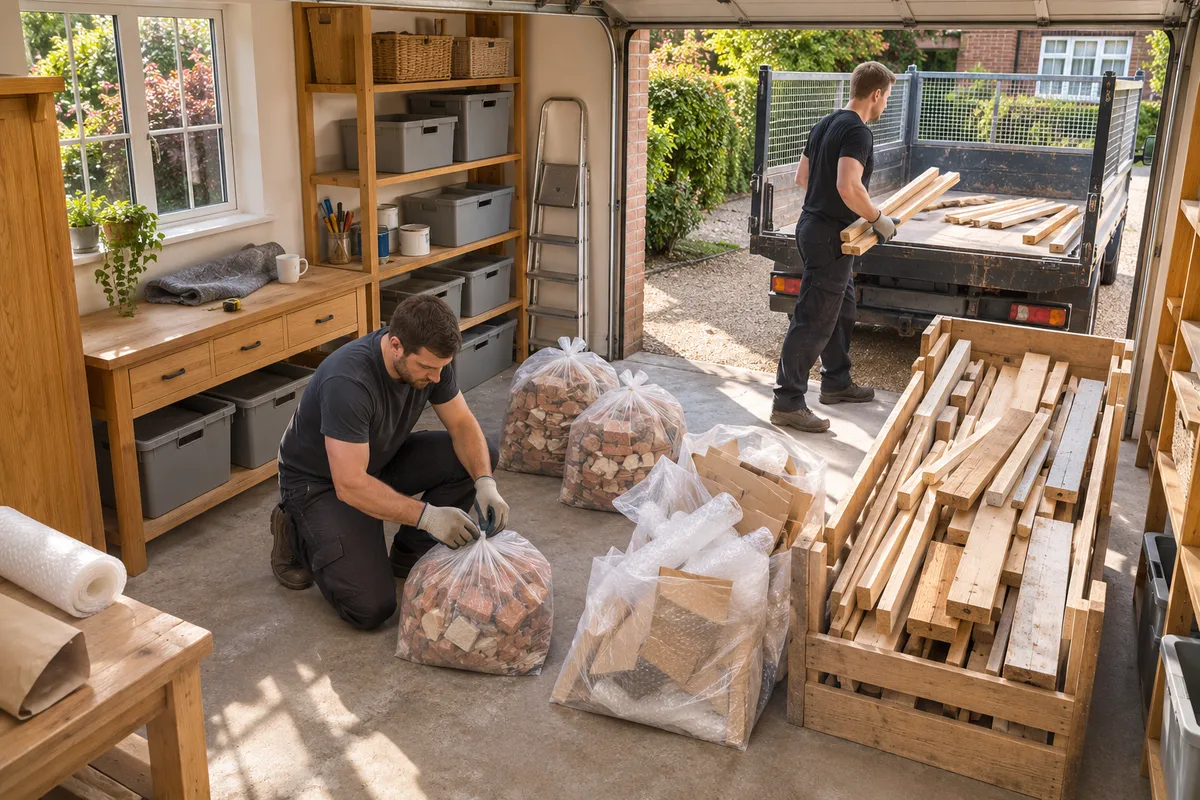
Empty packaging and containers are different from boxes holding products, liquids or project debris. State what is known about their contents and identify anything uncertain. Unknown chemicals, paints or potentially hazardous material need to be raised before booking so acceptance and any specialist requirement can be discussed. Do not open an unsafe container simply to improve an estimate. Name electrical equipment and appliances separately, including connection work remaining. If renovation leftovers are included, distinguish timber, tiles, rubble and wrapping by material and approximate amount. Household boxes also need a general contents description, particularly for dense books or crockery. We do not assume every material stored at a workplace is accepted as ordinary business waste. Clear groups let us discuss the complete proposed collection and responsible onward handling without discovering a hidden material stream while loading.

| Load | Service | Key detail |
|---|---|---|
| Work furniture | Office clearance | Furniture and electronics |
| Private contents | House and flat clearance | Separate ownership |
| Project debris | Builders clearance | Material and density |
| Outdoor additions | Garden waste collection | Actual type and route |

A fictional mixed-ownership collection
Imagine a small business reorganising a workroom while an owner also removes personal boxes stored there. The business authorises redundant desks and an empty cabinet. The owner authorises checked household belongings, while live equipment, stock and landlord fittings stay. This is an illustrative planning example, not a completed Hayes job. We would separate the two instructions and ask who can confirm each. The cabinet contents and furniture construction would be clarified, along with the route from the store to the service entrance. If old containers are discovered behind the desk, their contents need discussion before inclusion. The representative could then confirm the final load and price before carrying. Sharing one premises can make a combined enquiry convenient, but it does not merge ownership or remove the need to identify different materials and work.
Agree the full quote with an informed representative
Our quote follows amount, material mix, carrying and additional work agreed. We do not invent a Hayes mixed-business tariff or treat a desk count as a complete assessment. Private boxes, electrical items, dense materials and dismantling requirements should be included explicitly. Tell us timing needs and ask about current availability; an enquiry does not itself reserve a slot. Before loading, update us if another person has removed part of the group or new material has been added. Changes in access also matter, including a yard that can no longer be used. The person present should understand both authorisations and the price being agreed. A clear arrangement lets the team follow a defined instruction while the organiser retains control over the business and personal contents. It also makes additional requests identifiable rather than automatically expanding a collection because they share the address.
| Point | Confirm | Reason |
|---|---|---|
| Authority | Both owners approve | Defined instruction |
| Access | Key holder and route | Available carrying |
| Quote | Final material mix | Accurate scope |
| Handover | Separate groups checked | Clear completion |
See the current collection price guide, then confirm your complete quote with us. No separate Hayes tariff is implied.
Review each ownership group at completion
After loading, check business furniture and personal contents separately against their lists. Confirm that retained stock, live equipment and third-party property remain. The load leaves for responsible onward handling, with reuse and recycling considered where suitable to condition and material. We do not guarantee every workplace item has the same destination or claim an unsupported local recycling percentage. Collection does not automatically include reorganising stock, transporting retained belongings elsewhere, fitting new furniture or cleaning the premises. Discuss separate requirements explicitly. If clearing one group exposes more unwanted material, identify it and agree any addition before loading. A defined handover makes the result clear for both owners, even where the wider workplace reorganisation continues. The authorised waste has gone and the remaining tasks keep their own scope.

LOCAL COLLECTION AREA
Where we collect in Hayes
The map identifies Hayes’s verified London place position for orientation, not a depot or borough-wide marker. Provide the complete postcode and actual workplace entrance so the specific premises and loading route can be discussed.
Nearby collection areas: Yeading · Hillingdon · Southall
Our London and M25 coverage is described on the Areas We Cover page. The local information here concerns the collection enquiry; it does not create a separate neighbourhood branch.

Greater London reference outline: GLA / OS Open Data (OGL). Location: GeoNames UK gazetteer. This is an orientation map, not a service boundary or branch address.
COLLECTION QUESTIONS
Hayes removal enquiries: questions answered
Can private boxes join a business-furniture enquiry?
Describe them separately and establish the owner’s authority. We can discuss the complete proposed collection, but a business representative should not automatically authorise another person’s belongings merely because they share the premises.
Does an empty-looking cabinet need checking?
Check drawers and cupboards for records, keys and personal items. Explain whether the furniture is empty and identify contents also leaving separately. We do not decide what the owner should retain.
Can old product containers be called packaging?
State whether they are empty and describe any contents or uncertainty. Liquids, chemicals and other material can change acceptance requirements. A closed container is not automatically ordinary wrapping.
What if the postal entrance is not the service door?
Give the full address and explain the actual collection entrance, gates and shared access. Confirm permission for the proposed loading position. The map marker alone does not identify the right route.
Who should attend a mixed-ownership collection?
Nominate someone who understands both authorised lists and can answer questions. Settle decisions beforehand rather than asking the team to infer ownership. Arrange ongoing access as well as approval of contents.
Will retained contents be moved elsewhere afterwards?
Transporting retained belongings, reorganising stock and installing furniture are separate requirements. Our agreed removal concerns specified unwanted contents. Discuss additional work explicitly so the service endpoint remains clear.
All generated photographs on this page are illustrative service scenes. They do not document jobs in Hayes.
Discuss your Hayes collection
Call +44 20 3404 3985 with the collection postcode, item list and property details. We will discuss the scope, available arrangements and quote before work begins.
Services for your Hayes enquiry
Furniture disposal · Rubbish collection · House and flat clearance