
LONDON & THE M25
Junk Removal
in Hook.
This is our collection page for Hook in the Royal Borough of Kingston upon Thames, within Greater London. Give us the full postcode so the enquiry is tied to this locality and the actual property. We remove agreed unwanted furniture, household rubbish, garden material and business contents, with carrying and loading discussed before booking. A clear description of the load and its route out matters more than a broad instruction to clear the place. We establish the contents, practical access and complete price before work begins.
- Carrying and loading included
- A clear quote before work begins
- Licensed and insured waste carrier

THE CARRYING ROUTE
Planning the Hook carrying and loading
01
Confirm Hook, Kingston
Send the full address and collection entrance details.
02
Set the removal list
Identify contents and the rooms or stores involved.
03
Describe access
Include side gates, stairs and the loading proposal.
04
Agree scope and quote
Confirm accepted materials, work, price and availability.
05
Carry and remove
We load the agreed unwanted items for responsible handling.

Make the locality and entrance unambiguous
Hook is also a place name elsewhere, so we begin with the postcode and complete address for the Kingston locality. The council’s Hook character study identifies Hook Road as the area’s central spine, with Hook Parade a local focus and residential streets to the east and west. We use that verified context for orientation, not as a substitute for your property’s entrance details. Tell us whether the collection is from a house, flat, garage or business and whether the door used for access differs from the postal frontage. A side gate or rear store may have its own keyholder. Those details should be included before arranging the visit. We do not imply an office in Hook or promise a particular route from a motorway simply because the area has road connections.
A family-house clearance can cover only the named rooms
We can discuss a defined household load through domestic clearance, whether it comes from one room, several rooms or storage outside. Start with the objects rather than call it a full house clearance when much of the home remains furnished. Tell us which furniture is unwanted and identify loose contents such as boxes, bags and small shelving. If family members are keeping different things, establish the removal list before the visit. An attending representative should understand what is staying as clearly as what is leaving. We do not decide ownership from the way objects are grouped. A wardrobe that looks unused may still belong to someone else, and a box beside rubbish may hold retained documents. Clear instructions help us arrange the agreed removal without assumptions about the whole property.
ADDRESS & LOADING
Semi-detached housing does not guarantee side access
The council study describes substantial areas of semi-detached and short-terrace housing in Hook, including inter-war development. Property type alone still does not tell us whether a garden route is usable. A side passage may narrow at a gate, contain steps or be occupied by retained items. Explain the actual route from the contents to the proposed loading point. If outdoor material must pass through the house, include that in the enquiry. For an upstairs room, describe the stairs and turns as well as the front door. We carry and load the agreed waste, so you can leave bulky pieces in their present positions while the work is discussed. Do not assume that a gap beside the house allows every cabinet, branch or appliance to pass through without further consideration.
- Use the complete postcode to identify Hook in Kingston
- Define the rooms included while the rest of the home stays in use
- Explain the real side-gate opening rather than assume access from house type
- Give the attending relative the same removal list
- Name soil, rubble and appliances outside a general bag count

| Information | Useful example | Purpose |
|---|---|---|
| Correct locality | Hook in Kingston with full postcode | Avoids ambiguity with other places named Hook |
| Included locations | Spare room and rear garden | Every carrying route is considered |
| Authorisation | Occupier or named family representative | Retained belongings remain clearly excluded |
| Loading proposal | Driveway, road or managed yard | Access and restrictions can be checked |
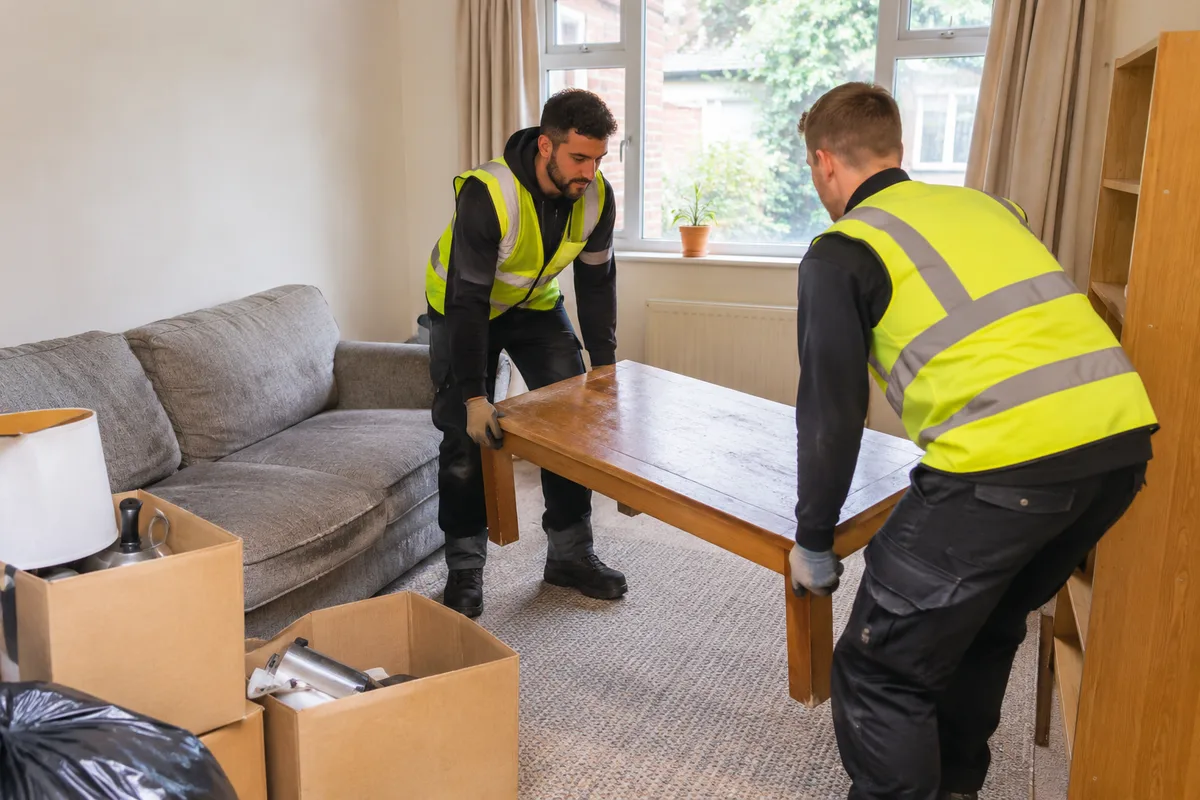
Illustration: clearing a room while keeping the home in use
Imagine a Hook household turning a spare room into a study. An old bed, mattress and chest of drawers are unwanted, while books and a desk are staying. The household also wants bags of cuttings collected from behind a garden gate. This is an illustrative enquiry, not a claim about a completed customer job. We would ask whether the bed is assembled, what floor the room is on and whether the drawers can follow the stair turn. We would also ask whether the garden bags contain only cuttings or include soil and broken pots. The indoor and outdoor contents form one discussion but have different locations and material descriptions. If a relative is meeting our team, they should have the agreed list so retained books or furniture are not included by mistake.
Furniture dimensions and condition belong in the first message
For furniture disposal, identify sofas, wardrobes, tables and beds individually. Measurements help where a hall, door or stair turn looks tight. Tell us whether the piece is freestanding, already dismantled, fixed in place or damaged. Requested dismantling should be discussed before the quote is agreed; removing fitted cupboards is not automatically part of carrying loose furniture. Broken glass, loose panels and unstable components also need mentioning. If an appliance accompanies the furniture, name it separately and explain whether it is connected. A refrigerator is not described accurately as another box in the load. Our enquiry should reflect the actual contents and handling, including any additional requirement that may affect the work. It is better to agree those details before the visit than leave them implicit in a general clearance request.
| Contents | Explain | Relevant service |
|---|---|---|
| Bed and drawers | Size, assembled condition and floor | Furniture disposal |
| Boxes and bags | Actual contents and approximate amount | Rubbish collection |
| Outdoor bags | Cuttings distinguished from soil and broken pots | Garden collection |
| Refit leftovers | Rubble, timber and plasterboard identified | Builders clearance |
Garden and renovation materials need distinct descriptions
Green cuttings, timber, soil and rubble can all stand outside, but their location does not make them the same waste type. For garden collection, describe branches and cuttings, with their approximate amount and whether they are bagged or loose. For building waste, distinguish rubble, tiles, timber and plasterboard. Dense material needs to be identified rather than hidden inside an ordinary bag count. Tell us about long pieces or sharp components too. Collection does not automatically include gardening, landscaping or finishing renovation work. Unknown containers, chemicals and suspected hazardous material should be raised separately before booking. We discuss acceptance of the proposed contents and do not treat ordinary rubbish beside a substance as evidence that every material can be collected together.


Loading follows the street and property, not one rule for Hook
Give us the proposed loading position and explain its relationship to the entrance. It may be a driveway, shared court, service yard or public-road location. Private spaces can have barriers or management conditions, and public roads need the applicable restrictions checked. Kingston Council’s street-parking information is the official reference for road-level conditions. We do not promise that an empty space is suitable simply because it is near the door. Describe any known access control and the person who can arrange entry. We also need the carrying route from each included location, such as an upstairs room and rear garden. A collection appointment is discussed with current availability; we do not invent travel times or guaranteed arrival windows from the Hook place name.
See the current collection price guide, then confirm your complete quote with us. No separate Hook tariff is implied.
| Situation | Discuss | Do not assume |
|---|---|---|
| Fitted cupboard | Removal work beyond carrying | All joinery is included |
| Connected appliance | Condition and any additional work | Disconnection is automatic |
| Extra room | New contents and carrying requirements | Earlier quote expands without review |
| Business equipment | Authorised list and specialist requirements | Collection includes data destruction |
The complete price and onward handling are explained together
Our published price guide provides starting bands and relevant supplements. The full collection quote needs the amount, materials, specific items and work agreed, including any stairs or requested extra tasks. If another room, appliance or building-waste pile is added, tell us before loading so the scope can be reviewed. A business enquiry should also identify who authorises removal and distinguish unwanted furniture or equipment from retained stock and landlord fixtures. Our office clearance and shop services concern agreed contents, without assuming specialist data destruction or a full strip-out. After carrying and loading, we take the accepted waste away for responsible handling, seeking reuse and recycling where possible. We do not guarantee that every item is reusable or attach a fabricated recycling rate to a Hook load. The collection covers the defined removal, with unrelated work discussed separately.

LOCAL COLLECTION AREA
Where we collect in Hook
Hook here means the Kingston upon Thames locality in Greater London, with Hook Road and Hook Parade identified in the council character study. The map marks that locality and is not a business address. Provide your precise postcode for collection enquiries. Chessington and Tolworth are nearby named areas, with appointments arranged around the actual contents and access.
Nearby collection areas: Chessington · Tolworth · Surbiton
Our London and M25 coverage is described on the Areas We Cover page. The local information here concerns the collection enquiry; it does not create a separate neighbourhood branch.

Greater London reference outline: GLA / OS Open Data (OGL). Location: GeoNames UK gazetteer. This is an orientation map, not a service boundary or branch address.
COLLECTION QUESTIONS
Hook removal enquiries: questions answered
Is this collection page for Hook in Hampshire?
This page concerns Hook in the Royal Borough of Kingston upon Thames within Greater London. Give the full postcode when you enquire so the location and property can be checked. The place name alone is not enough to establish the collection address or confirm coverage for another locality.
Can you remove a spare-room load while the rest of the house stays furnished?
Yes, list the unwanted pieces and explain which belongings are staying. We can discuss a limited domestic clearance without treating the whole home as part of the job. An attending representative should have the same list, particularly where family members are keeping different items nearby.
Does a semi-detached house automatically provide a garden route?
We need the actual access description. A side passage can have a narrow gate, steps or other obstacles, and some contents may need to pass through the house. Explain the route from the waste to the proposed loading point rather than rely on the property type alone.
Can a mattress and bags of cuttings be discussed together?
Include both in one enquiry, naming the mattress and describing the bags’ contents and location. Soil, rubble and broken pots should be distinguished from green cuttings. We discuss the complete mixed load and carrying work so the full quote reflects the actual collection rather than an ordinary bag count.
Will you take a cupboard that is fixed to the wall?
Tell us that it is fitted or fixed and describe the additional work requested. Ordinary furniture carrying does not automatically establish removal of joinery or making good the wall. The work and its price need explicit agreement before it is treated as part of the collection.
Does the price guide confirm my Hook collection booking?
The guide provides published price information, while a booking needs the full contents, access and current availability discussed. Ask for the complete quote for your agreed load and work. Additional items or changed carrying requirements should be raised before loading rather than assumed to fall within the original arrangement.
All generated photographs on this page are illustrative service scenes. They do not document jobs in Hook.
Discuss your Hook collection
Call +44 20 3404 3985 with the collection postcode, item list and property details. We will discuss the scope, available arrangements and quote before work begins.
Services for your Hook enquiry
Furniture disposal · Rubbish collection · House and flat clearance