
LONDON & THE M25
Junk Removal
in Perivale.
A space used for both living and work can contain several ownership and material groups in a small area. We organise Perivale junk removal by identifying what leaves, what stays and which entrance serves each group. We agree the collection and carrying, then load the specified contents for responsible onward handling.
- Carrying and loading included
- A clear quote before work begins
- Licensed and insured waste carrier

FROM ENQUIRY TO REMOVAL
Perivale collections: the process we agree
01
Define both content groups
Separate household and work decisions.
02
Describe components and route
Identify materials and actual entrance.
03
Agree the complete quote
Confirm additional work and changes.
04
Review the cleared group
Check retained functions before onward handling.
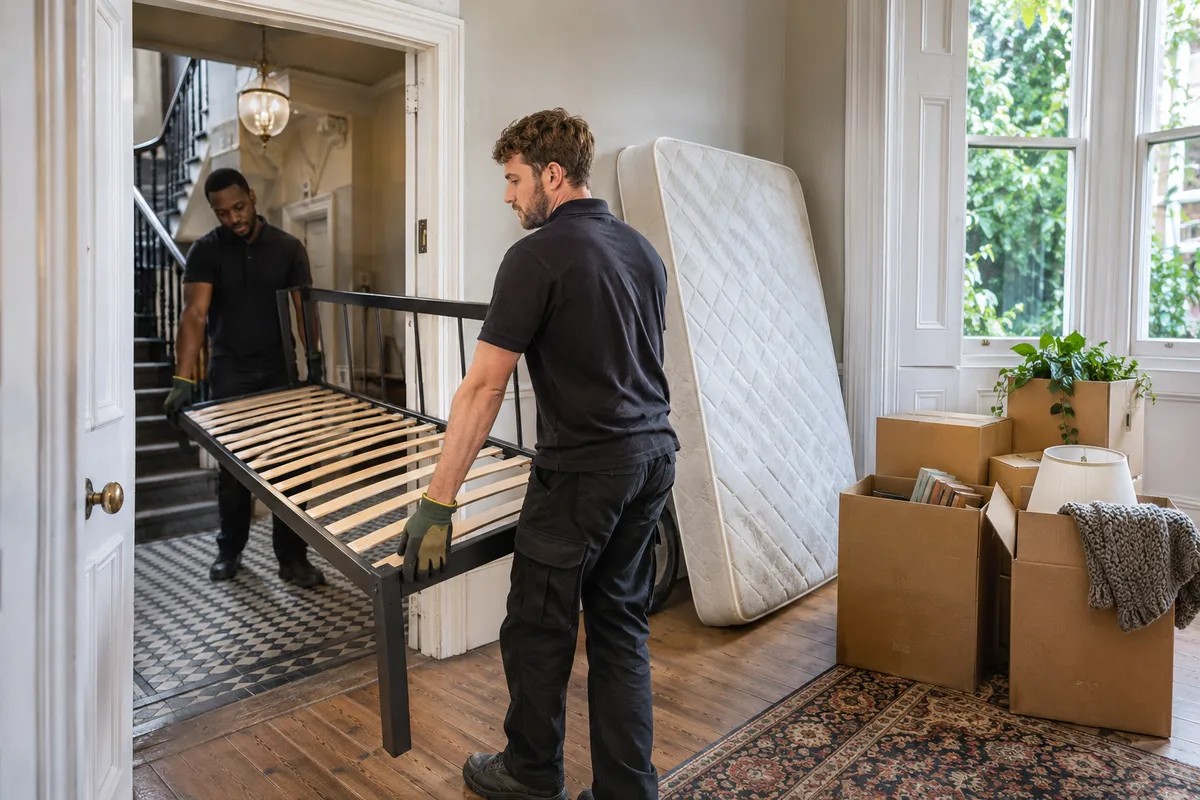
Define the boundary between work and household contents
Tell Junk Please which unwanted groups belong to the household and which relate to work. A desk can stand beside domestic shelving and personal boxes, but the same person may not own every device or cabinet. Settle authority before including equipment in the collection. List substantial furniture individually and describe loose contents by general type and approximate quantity. Identify retained belongings explicitly rather than asking to clear the whole space if some functions remain in use. We do not decide whether work equipment is obsolete or personal possessions have value. Nominate someone who understands the final list and can confirm it at the visit. A defined boundary lets the collection support the room reorganisation without assuming everything in a mixed-use space should leave. It also gives the representative a clear basis for checking the result after loading.
Separate furniture panels and loose material
Shelving and desks may be assembled, already in panels or attached to the building. Describe their actual condition and discuss any further dismantling explicitly. Removing loose components is different from taking down fitted storage. Identify every panel, drawer or pedestal intended for collection and say which parts remain. Check cupboards for records, keys and other retained contents before the furniture joins the load. We do not assume ordinary junk removal includes confidential-document destruction or decisions about personal papers. If cardboard, metal or timber is present, describe the groups separately rather than presenting an indistinct pile. Give useful amounts and explain what containers hold. A clear component and material list makes the quote more useful and prevents a furniture description concealing unagreed work or contents. Keep retained groups apart where practical without blocking the carrying route.
Use Perivale’s canalside context carefully
Ealing Council’s Canalside conservation information includes Perivale among the wards in its extent. This provides a specific official local context, not an assertion that every Perivale address is within the conservation area. It also does not establish a vehicle route along a towpath. Give us the full postcode and actual premises entrance. A residential door and a workspace service entrance may differ even where the contents share an address. Explain which route is available for each group and who can authorise shared space. We do not assume access across public or neighbouring land because it looks direct on a map. The official Canalside information supplies background rather than loading permission. The existing property arrangement and relevant restrictions at the proposed position need their own consideration before a collection route is treated as available.
- Separate work and household authorisations
- Identify furniture panels and retained components
- Name devices apart from boxes
- Explain which entrance serves each group
- Keep canalside public access separate from private loading

| Group | Describe | Retain separately |
|---|---|---|
| Desk | Components and construction | Current devices |
| Shelving | Loose or attached | Files and books |
| Boxes | General contents and amount | Personal papers |
| Materials | Cardboard, metal or timber | Usable parts |
Explain how the living space stays usable during removal
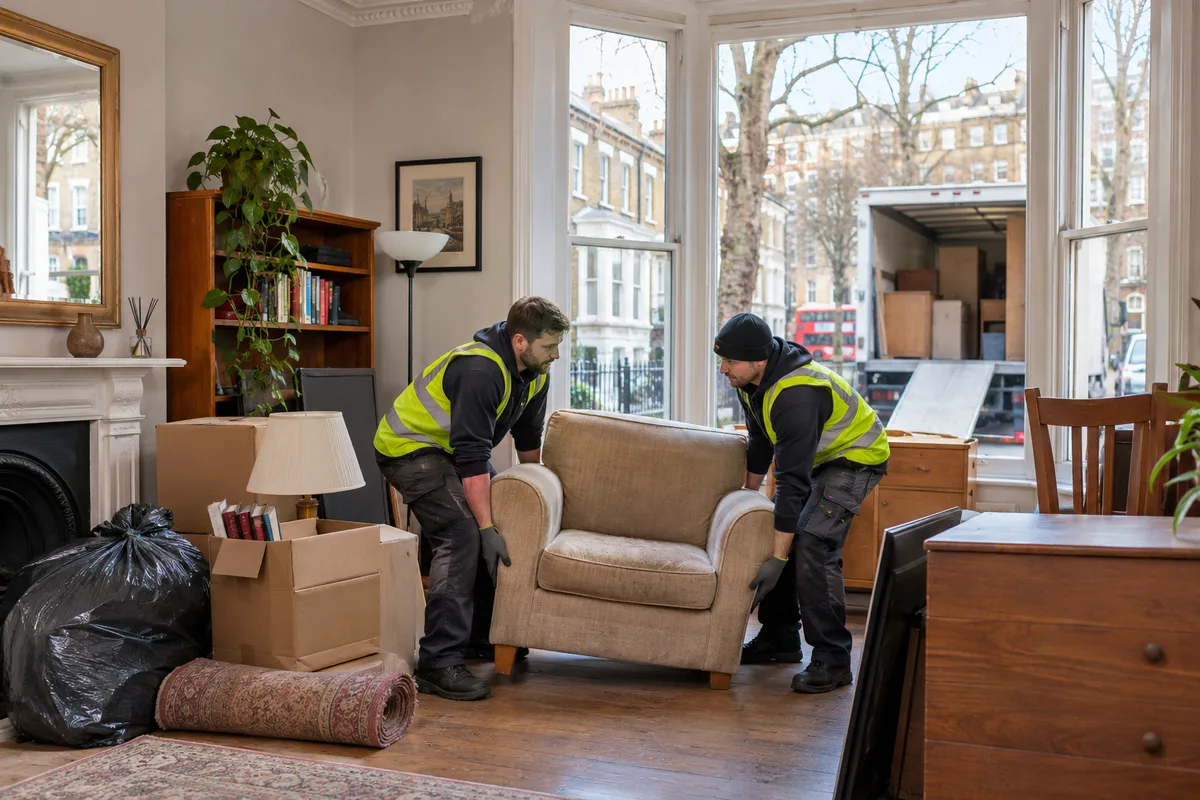
Describe the working corner in relation to the furniture that remains. A desk may have been squeezed behind seating, with panels stacked against a bookcase and only one path to the door. Tell us which objects are part of the collection and which cannot be disturbed. If the residential entrance differs from a workspace access, explain both rather than choosing the apparently shortest route from a map. The largest desk panel is a useful reference for doorways and turns. State its size and whether it is already loose. We can then discuss the carry from the actual arrangement, instead of assuming a cleared office with open floor space. There is no need to rearrange heavy retained furniture yourself simply to demonstrate access. What matters is a realistic account of the space our team would find.
Turn the mixed corner into identifiable removal groups
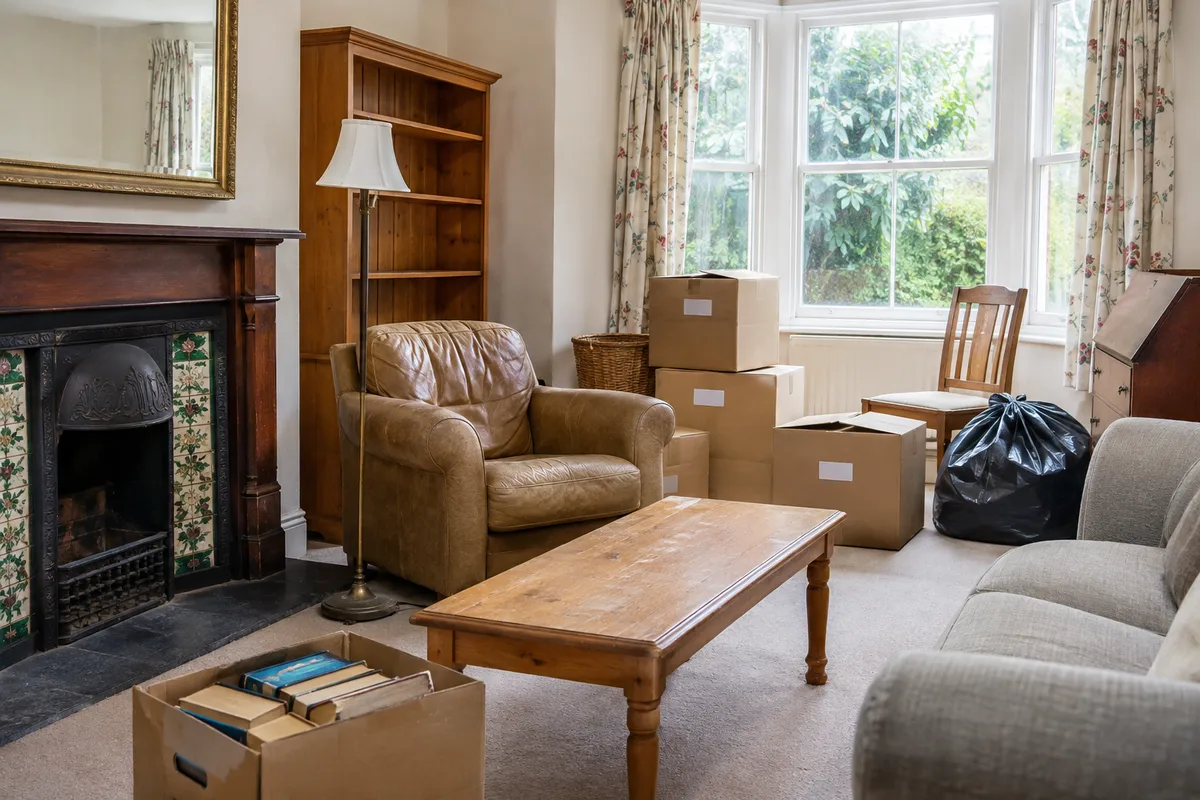
Describe the desk and shelving parts first, then the separate cardboard, metal and boxed household contents. This makes it possible to understand what the loose pile contains without guessing from its appearance. Say whether small metal pieces belong to unwanted furniture or are useful parts being retained. Devices should have individual names and clear ownership; a printer beside an old desk is not automatically redundant. Keep any retained information and current working equipment out of the group approved for collection. If a container holds something uncertain, state that uncertainty rather than combining it with ordinary household bags. We discuss whether it fits the proposed service. The useful outcome is not a perfectly sorted room but an intelligible inventory, with no material or owner silently included because their belongings happen to share the working corner.
| Contents | Service | Detail |
|---|---|---|
| Household belongings | House and flat clearance | Furniture and loose groups |
| Work setup | Office clearance | Authority and devices |
| Project material | Builders clearance | Density and quantity |
| Outdoor additions | Garden waste collection | Material and route |

A fictional mixed-space reorganisation
Imagine a household reducing its working area to create more living space. An old desk, dismantled shelving and boxes of ordinary contents are unwanted. A laptop, current files and seating remain. Separate cardboard and metal components are also proposed for collection. This is a planning illustration, not a completed Perivale job. We would identify the desk components and confirm ownership of the work items. The boxes and loose material groups would be described independently. We would then ask which entrance serves them and how the furniture passes through the remaining room layout. If an old monitor is added, it needs to be named before inclusion in the quote. A settled inventory lets the collection proceed as a defined task while the household’s new layout and retained work setup remain separate decisions.
Use the final layout decision in the price discussion
The room reorganisation may change which pieces are unwanted. A shelf initially included could become useful elsewhere, while dismantling the desk may reveal a separate pedestal you want removed. Bring those decisions into the enquiry before agreeing the collection price. State which panels and box groups remain for us and where they now stand. If another household member has taken the metal components for their own use, remove them from the proposed inventory rather than leaving their status ambiguous. Describe any additional preparation you are asking us to undertake, separately from carrying items already loose. Availability can be discussed against that settled task. The price reference should be a defined group of furniture parts and contents, connected to an actual entrance, rather than a request to make the combined space feel less crowded.
| Point | Confirm | Purpose |
|---|---|---|
| Ownership | Both functions authorised | Clear instruction |
| Entrance | Residential or service route | Actual carrying |
| Quote | Final material groups | Accurate scope |
| Handover | Retained functions protected | Defined completion |
See the current collection price guide, then confirm your complete quote with us. No separate Perivale tariff is implied.
Review the parts that supported the old arrangement
At completion, check the old desk components, unwanted shelving and loose-material groups. A panel resting in a different room may still belong to the approved load, so identify those locations before the visit. Confirm that current devices and the household seating remain as intended. The collection should leave a clear distinction between the setup removed and the functions still in use, without promising to install the new layout. Materials are considered for onward handling according to their nature and condition, with suitable reuse or recycling explored rather than one outcome asserted for everything. Reconnecting a retained printer or choosing where a new desk will stand is a different task. If the household subsequently changes its mind about another unit, that decision needs a fresh description. This gives the completed removal a stable boundary despite an evolving room plan.

LOCAL COLLECTION AREA
Where we collect in Perivale
The map identifies Perivale’s verified place position for orientation, not a depot, towpath entrance or service boundary. Send the complete postcode and actual residential or workspace access for the collection.
Nearby collection areas: Alperton · Hanger Lane · Wembley
Our London and M25 coverage is described on the Areas We Cover page. The local information here concerns the collection enquiry; it does not create a separate neighbourhood branch.

Greater London reference outline: GLA / OS Open Data (OGL). Location: GeoNames UK gazetteer. This is an orientation map, not a service boundary or branch address.
COLLECTION QUESTIONS
Perivale removal enquiries: questions answered
What if the desk is behind furniture we are keeping?
Describe the available path and the retained pieces that limit it. Show the largest desk component and explain the doors or turns. A mixed living space should not be described as an empty office.
How should small metal components be listed?
Say whether they belong to unwanted furniture or are usable parts being retained. Include the agreed quantity and location so they are not inferred from a photograph of a mixed pile.
Does a printer beside the desk automatically leave?
No. Give it a separate decision and ownership description. Current equipment and information should remain clearly outside the removal group even when the surrounding furniture is unwanted.
What if the room plan changes before collection?
Update the inventory to show the pieces now leaving, their locations and any preparation needed. The price discussion should follow the settled task rather than the first layout idea.
Can you use whichever entrance appears shorter?
Explain the actual residential and workspace arrangements, including permission. A route shown on a map or through public canalside space is not automatically available for the proposed collection.
Will the remaining equipment be reconnected?
Reconnecting or installing retained devices is a separate requirement. The removal check should identify the old setup taken away and the live functions left in place.
All generated photographs on this page are illustrative service scenes. They do not document jobs in Perivale.
Discuss your Perivale collection
Call +44 20 3404 3985 with the collection postcode, item list and property details. We will discuss the scope, available arrangements and quote before work begins.
Services for your Perivale enquiry
Furniture disposal · Rubbish collection · House and flat clearance