
LONDON & THE M25
Junk Removal
in Queensbury.
A workroom at home can contain business equipment, family possessions and furniture that no longer fits its purpose. We organise Queensbury junk removal around the groups you have decided to remove. We discuss the contents, ownership and access, agree the collection quote, then carry and load the specified items for responsible onward handling.
- Carrying and loading included
- A clear quote before work begins
- Licensed and insured waste carrier

FROM ENQUIRY TO REMOVAL
Queensbury collections: the process we agree
01
Choose the removal group
Separate work equipment and household possessions.
02
Prepare retained contents
Keep files and devices that are staying apart.
03
Agree access and price
Describe the route and full material mix.
04
Review the clear space
Check agreed components before onward handling.
Define the workroom you want to use again
A room used for work rarely contains only work equipment. It may also hold household boxes, an old dining chair, spare storage and personal paperwork. Tell Junk Please which groups are leaving and which remain in use. A request to clear the office should not become permission to remove every object from a room that serves several purposes. Identify substantial furniture individually and describe loose contents separately. Explain whether desks are empty and whether storage units still contain possessions. If you work for an employer, settle who owns the equipment and who can authorise its removal before the collection is arranged. We should not be asked to infer ownership from where a computer or cabinet stands. A defined list lets us discuss the actual carrying and loading while preserving the belongings that still support the household or business. The purpose is to remove the agreed unwanted group, with the next use of the room guiding your decisions rather than expanding our instruction automatically.
Handle paperwork decisions before furniture moves
Empty drawers and cupboards carefully when their contents are being retained. Personal documents, work records, keys and small devices can remain hidden inside furniture that appears ready to go. We do not decide which records should be kept or promise that ordinary junk removal provides specialist confidential-document destruction. Tell us if that is a separate requirement rather than putting sensitive material among general household waste. Keep the approved removal group distinct from files and equipment still needed. If several people use the room, nominate one person who can confirm the finished list and answer questions at the visit. A desk collection should specify whether drawer units, cable trays and loose components are included. If one storage pedestal stays, explain that clearly. This preparation is useful even for a small collection: it prevents a furniture description from concealing unresolved decisions about the contents. It also gives the team an instruction that can be checked when loading is complete.
Queensbury needs an entrance description of its own
Harrow Council identifies Queensbury Park with entrances on Honeypot Lane and Clifton Road. The familiar local landmark can help someone describe their surroundings, but it is not a collection address or permission to use public land for loading. Give us the complete postcode and actual entrance to your property. A workroom reached through a house, a flat with a shared lobby and a separate garden office involve different carrying routes. Explain which one applies, including gates, steps and any private access arrangement. We do not assume a route through neighbouring land or a park because it appears shorter on a map. Confirm authority for any managed courtyard or driveway proposed for loading. The council’s Queensbury Park information supplies a precise local reference; the collection should still be planned around your premises and the access genuinely available. Street restrictions likewise need to be considered for the relevant loading position rather than inferred from the locality name.
- Settle ownership of work equipment before collection
- Empty retained papers from unwanted storage
- Name electronics separately from desks
- Describe fixed units and any proposed dismantling
- Explain the route from the workroom to loading

| Group | Decision | Useful description |
|---|---|---|
| Desk | Which components leave | Size and dismantled condition |
| Storage | Furniture and contents decided separately | Empty or containing unwanted belongings |
| Devices | Authorised for removal | Type and unplugged condition |
| Household additions | Included explicitly | Boxes and general contents |
Separate desks from electrical equipment
A redundant desk and the devices placed on it are different parts of the load. Name computers, monitors, printers and other electrical equipment individually, and say what is unplugged and ready for collection. Do not assume that a request to remove office furniture includes disconnecting equipment or managing data. Explain any task beyond straightforward carrying and loading before the visit. Keep cables and small components together where they are part of an agreed group, while retained equipment remains separate. A home office can also contain household appliances awaiting another decision, so identify those rather than hiding them under electronics. If a device belongs to an employer or another person, obtain the relevant authority before including it. The enquiry needs the actual material mix as well as the furniture count. This helps us discuss acceptance, applicable charges and responsible onward handling without treating everything in a workroom as identical general rubbish.
Plan the desk’s journey through the house
A desk that fits neatly into a room can still be awkward to carry through a landing or porch. Tell us its approximate dimensions, construction and whether it is already dismantled. Any proposed dismantling needs to be discussed explicitly, especially for fixed shelving or a unit attached to the building. We do not assume permission to remove fixtures because they are near unwanted furniture. Describe the floor, stairs, turns and narrowest doorway, then explain the path to the loading position. For a garden workroom, include the side gate and outdoor surface. If the route crosses another room full of retained belongings, tell us what space is available. Keep the passage clear where practical but do not attempt an unsafe heavy lift to prepare it. The collection quote should reflect the existing route and agreed work. If furniture is moved to a different location before the visit, update the description so everyone understands where carrying will begin.


| Contents | Service | Distinction |
|---|---|---|
| Household furniture | House and flat clearance | Furniture versus contents |
| Work equipment | Office clearance | Desks versus electronics |
| Garden additions | Garden waste collection | Objects versus cuttings |
| Project debris | Builders clearance | Density and material type |

A fictional home-office reorganisation example
Imagine a household replacing a large desk with a compact working arrangement. The unwanted group includes the desk, a low cabinet and two chairs, while a printer, family files and a bookcase are staying. Several boxes of ordinary household belongings are also proposed for collection from a neighbouring room. This is an illustrative planning scenario rather than a completed Queensbury job. We would distinguish the furniture from the boxes and ask whether the desk is dismantled. We would confirm that the cabinet is empty and that retained devices have been separated. If an old monitor is added, it needs to be named and discussed rather than treated as part of the desk automatically. The household would explain the stairs and front entrance, along with the available loading position. With those details, the enquiry can progress towards a defined quote. The room’s new purpose is useful context, but the list of authorised unwanted contents remains the basis of the visit.
Confirm the complete collection before quoting
Our price discussion considers the amount, material types, carrying requirements and any agreed additional work. We do not invent a Queensbury workroom tariff or assume two desks always represent the same collection. Drawers full of contents, electronics and extra boxes can change the description substantially. Tell us about timing needs and ask about current availability rather than treating an enquiry as a confirmed appointment. Before loading starts, the scope and price should match the actual group. If a colleague has collected a chair or more boxes have been added during sorting, update us. A change in access matters too, including a lift becoming unavailable or a garden gate that cannot be used. Share those details promptly so the arrangement remains clear. The value of a quote is its connection to the real load and work. It should not be based on an early photograph of a room whose contents have since been reorganised.
| Check | What to confirm | Purpose |
|---|---|---|
| Authority | Who owns the equipment | Clear removal instruction |
| Privacy | Retained records removed | Avoid unresolved contents |
| Route | Doors, stairs and loading | Understand carrying |
| Quote | Final materials and amount | Match the agreed job |
See the current collection price guide, then confirm your complete quote with us. No separate Queensbury tariff is implied.
Check the workroom handover against the list
After carrying and loading, review the agreed furniture and loose-content groups. Confirm that separate drawer units, panels and other components intended for removal have been included. Retained paperwork, devices and household possessions should remain outside the collection. The waste leaves for responsible onward handling, with reuse and recycling considered where appropriate to its materials and condition. We do not promise that every desk will be reused or that every electrical item has the same destination as household boxes. We also do not claim an unsupported recycling percentage for a Queensbury load. Removal does not automatically include installing the new desk, arranging cables or cleaning the whole room. Discuss any additional requirement explicitly. If the cleared space reveals another group of unwanted contents, describe it as a change or further request before it is loaded. A defined handover lets you continue the room reorganisation with a clear understanding of the collection completed.

LOCAL COLLECTION AREA
Where we collect in Queensbury
Queensbury’s OpenStreetMap suburb marker is shown for orientation. It is not a company office or loading location. Provide the complete postcode and actual property entrance; nearby public park access does not establish a route for a private collection.
Nearby collection areas: Kenton · Kingsbury · Burnt Oak
Our London and M25 coverage is described on the Areas We Cover page. The local information here concerns the collection enquiry; it does not create a separate neighbourhood branch.

Greater London reference outline: GLA / OS Open Data (OGL). Location: OpenStreetMap Nominatim. This is an orientation map, not a service boundary or branch address.
COLLECTION QUESTIONS
Queensbury removal enquiries: questions answered
Can I include employer-owned equipment in my home-office clearance?
Settle ownership and authorisation first. Tell us who can approve removal of the equipment. The fact that an item is stored at your home does not by itself establish that it belongs in the collection.
Does taking a filing cabinet include destroying the records inside?
Do not assume that ordinary junk removal includes confidential-document destruction. Remove retained records and discuss any specialist requirement explicitly. The cabinet and its contents need separate decisions in the removal list.
Can the desk go while the monitor and printer stay?
Yes. Identify the desk components being removed and keep retained devices clearly separate. A furniture collection does not automatically include equipment placed on top of it. Confirm the agreed group with the person present at the visit.
What should I say about a garden workroom?
Describe the entrance, gate, path and surface between the workroom and loading position. Give dimensions for bulky furniture and explain any fixed units. We need the actual route rather than only the postal address.
Can household boxes from another room be added?
Include their quantity, general contents and location in the enquiry. They form a distinct group alongside the furniture. Added material or another carrying route needs to be reflected in the collection scope and quote.
Will you reconnect the room after removing the desk?
Installing replacement furniture, arranging cables and reconnecting equipment are separate requirements. Our agreed removal concerns carrying, loading and taking away the specified unwanted contents. Discuss additional work explicitly before booking.
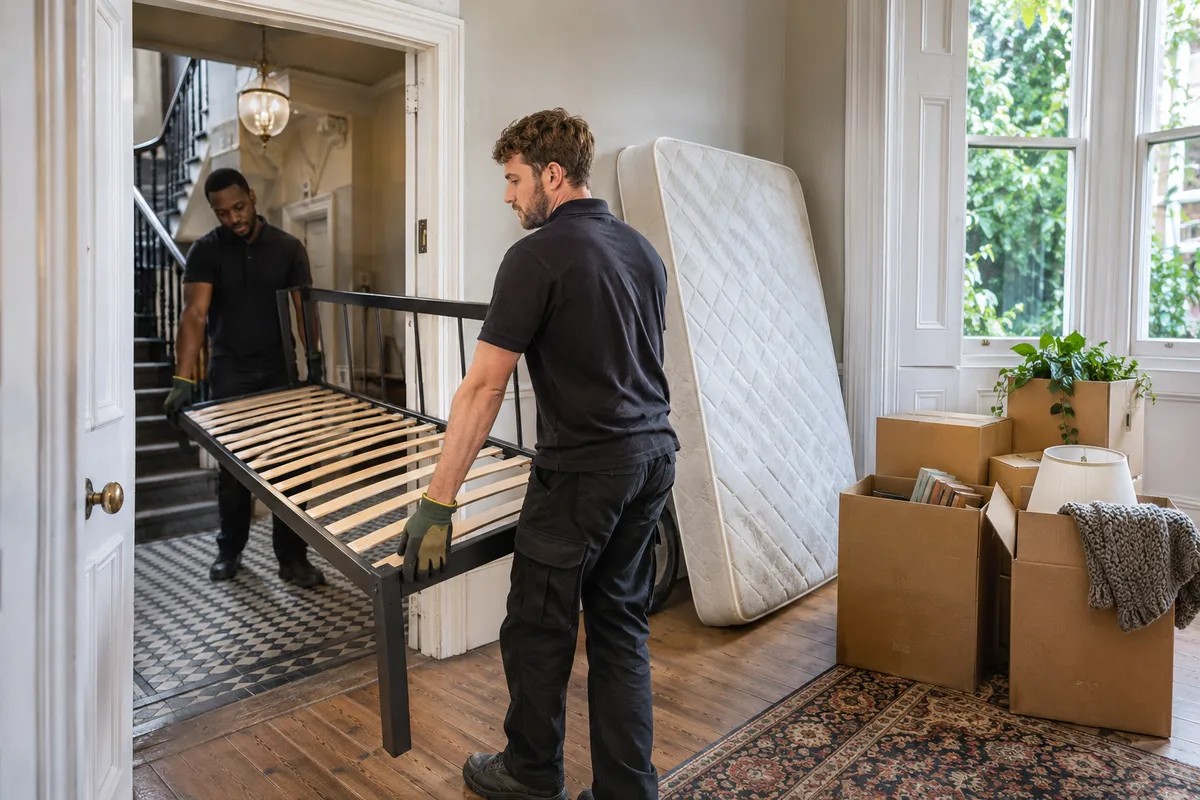
All generated photographs on this page are illustrative service scenes. They do not document jobs in Queensbury.
Discuss your Queensbury collection
Call +44 20 3404 3985 with the collection postcode, item list and property details. We will discuss the scope, available arrangements and quote before work begins.
Services for your Queensbury enquiry
Furniture disposal · Rubbish collection · House and flat clearance