
LONDON & THE M25
Junk Removal
in Wandsworth.
We arrange Wandsworth collections around the actual premises and unwanted contents, rather than treat the town name as a complete job description. A flat above a business, a house with stored furniture and a managed commercial space have different access questions. Give us the full postcode, entrance and removal list. Our team carries and loads the agreed items, with the complete price discussed before work begins. Include separate stores, retained belongings and any building contact so the enquiry covers the whole practical collection.
- Carrying and loading included
- A clear quote before work begins
- Licensed and insured waste carrier

THE CARRYING ROUTE
Planning the Wandsworth carrying and loading
01
Identify the premises
Give the postcode and actual collection entrance.
02
Confirm the authorised list
Separate household, business and retained contents.
03
Explain carrying and loading
Include floors, stores and managed access.
04
Agree scope and price
Confirm accepted materials, extra work and availability.
05
Carry and remove
We load the agreed contents for responsible handling.

Wandsworth town and the wider borough are distinguished
This page identifies Wandsworth locality rather than use the whole administrative borough as one place marker. The council’s Wandsworth Town appraisal describes a varied townscape of houses, commercial terraces and contemporary mixed-use development. That verified context explains why we ask about the actual property instead of assume one building type. Tell us whether the load is in a house, flat, office or shop and identify the entrance used for collection. A residential door can be separate from a ground-floor business frontage. Include the floor, entryphone, gate and any managed service access. The precise postcode and practical route are more useful than a nearby landmark when discussing carrying and loading. We do not invent a town depot, standard driving route or arrival time from the locality name.
Commercial and household contents need clear authorisation
A mixed-use building can contain possessions belonging to different occupiers and a landlord. Explain who authorises removal and distinguish the agreed contents from retained fixtures, business stock and personal belongings staying. Our domestic clearance, office clearance and shop services can be discussed for the relevant defined load. They do not automatically combine every part of a building into one clearance. A nominated contact should have the same list and be able to open every included room or store. We do not decide ownership from the age or appearance of furniture. Clear instructions are especially useful where a business entrance also leads towards residential access, or several people store items in the same rear area. The collection should follow an agreed inventory before carrying starts.
ADDRESS & LOADING
Furniture is described with its full exit route
A mixed-use building needs an object-by-object route, especially when business furniture and household furniture are discussed together. Identify which pieces start in the rear store and which are on an upper floor. Dimensions should address the particular door or turn likely to restrict them. Tell us whether shelves are freestanding, attached or already separated and whether loose glass or damage changes their handling. A request to remove a fitting is work to assess explicitly, rather than another ordinary chair on the inventory. Our furniture disposal discussion connects those objects to the actual exit. Keep the ownership distinction visible throughout: a neighbouring occupier’s sofa needs its own authority and location, even if it would eventually use the same gate as the business shelving.
- Use the actual Wandsworth postcode rather than the borough name alone
- Identify each occupier’s authority within a mixed-use building
- Separate monitors and repair debris from packaging
- Explain managed rear access and the contact controlling it
- Review the scope if a neighbouring household adds furniture
| Question | Information needed | Purpose |
|---|---|---|
| Which premises? | Household, business or separately authorised combined load | Scope does not expand to the whole building |
| Who authorises it? | Occupier or nominated business contact | Ownership is clear |
| Which entrance? | Frontage, rear store or managed service access | The actual route is identified |
| What remains? | Landlord fixtures, stock or neighbouring belongings | Retained contents stay excluded |

Illustration: a business store beside residential access
Imagine a Wandsworth business clearing old shelving, chairs and packaging from a rear store while a flat above remains occupied. This is an illustrative enquiry, not a completed-job account. We would ask which shelves are freestanding, what the boxes contain and whether the route uses a managed gate. The flat occupier’s furniture or bicycle should remain outside the instruction even if stored nearby. If old monitors are included, name them separately from packaging. We can then discuss the complete authorised business load and its carrying. A later request to add a sofa from the flat needs separate ownership, location and route details before relying on the original quote. The example shows why shared access does not make every adjacent object part of one clearance.
Equipment and repair debris are separate material groups
The business inventory should say what is behind the word equipment. Identify the screens, printers, computers or appliances included and state any specialist data or certification requirement as a separate service question. Give an appliance’s present installation condition so we can distinguish collection from work needed to release it. Refurbishment material also needs a contents breakdown: the approximate amount of each substance, how it is contained and whether long or sharp pieces are present. Cardboard and dense debris in one store are not interchangeable descriptions. Tell us about unknown containers before authorising the load, particularly where more than one occupier has used the space. We need to resolve material acceptance and requested work as part of the enquiry, rather than treat permission to enter the building as permission to remove every substance found there.
| Contents | Useful distinction | Relevant service |
|---|---|---|
| Shelving and chairs | Fixed or freestanding, size and condition | Furniture disposal |
| Packaging and boxes | Actual contents and approximate quantity | Rubbish collection |
| Electrical items | Equipment type and connected condition | Electrical collection |
| Refit material | Timber, tiles, rubble or plasterboard | Builders clearance |
Outdoor contents can require another access arrangement
If the collection includes a garden, garage or separate store, identify that location explicitly and explain who provides entry. A side gate may be narrow, a shared passage may need another contact and some material may have to pass through the property. For garden collection, distinguish already-cut green waste and branches from soil, rubble, furniture and equipment. State approximate amounts and bagged or loose condition. Collection does not automatically include pruning, landscaping or dismantling an outbuilding. Any extra task needs explicit discussion before the quote. Retained tools and other occupiers’ belongings should remain clearly excluded. We can discuss the combined enquiry while still recognising that indoor furniture and outdoor materials may involve different routes, access contacts and carrying work.


Loading is checked for the actual road or private space
Give us the proposed loading point and its relationship to the collection entrance. A public-road position needs applicable signs and restrictions checked, while private courts and service yards may have management conditions. Wandsworth’s parking information provides an official starting point, with actual location checks still relevant. An empty bay, residents permit or permission to enter a building does not establish every vehicle condition. Tell us about barriers, entry bookings and anyone controlling a service gate before the appointment is agreed. The loading proposal should connect to each included room or store. We discuss current availability with the complete job details rather than promise a universal exemption, immediate removal or an invented driving route from the town name.
See the current collection price guide, then confirm your complete quote with us. No separate Wandsworth tariff is implied.
| Detail | Confirm | Avoid assuming |
|---|---|---|
| Carrying | Floors, turns and outside steps | Boxes and sofas follow the same route |
| Extra tasks | Dismantling or fitted-item request | Every fixture is included |
| Loading | Actual restrictions and private entry | Building access settles road conditions |
| Complete quote | All materials, locations and authorised contents | Later additions are covered automatically |
The complete quote describes the agreed service
Before we confirm the full price, the authorised contact should be able to describe the same scope as the enquiry. Refer to the current guide for published bands and supplements, then include every accepted material group, location and carrying task in the complete quote discussion. A household addition from rooms above should identify its owner and route, rather than silently enlarge the business list. Changes to fixtures requested for removal also need review as work. We agree an available collection on that basis. The specified contents then leave after carrying and loading for responsible onward handling, with appropriate reuse and recycling opportunities considered for the actual material. We do not invent results for individual objects. Any cleaning, repair, installation or specialist service should be expressly defined so the handover reflects the collection that has been agreed.

LOCAL COLLECTION AREA
Where we collect in Wandsworth
Wandsworth town is a Greater London locality in the London Borough of Wandsworth. The marker identifies the town rather than a borough centroid or company depot. Give the precise postcode and actual entrance for collection enquiries. Battersea and Putney are nearby named areas, with access and availability agreed for the actual job.
Nearby collection areas: Putney · Barnes · Wimbledon
Our London and M25 coverage is described on the Areas We Cover page. The local information here concerns the collection enquiry; it does not create a separate neighbourhood branch.

Greater London reference outline: GLA / OS Open Data (OGL). Location: GeoNames UK gazetteer. This is an orientation map, not a service boundary or branch address.
COLLECTION QUESTIONS
Wandsworth removal enquiries: questions answered
Does this Wandsworth page identify the town or the whole borough?
It identifies Wandsworth locality for collection orientation. Give the exact postcode and entrance so the actual property can be discussed. Other named localities have their own pages; the administrative borough name alone does not establish the contents, route, loading conditions or appointment for a particular job.
Can a business store be cleared while a flat above stays occupied?
Describe the business contents and authorised contact, with the actual route and any managed gate. Identify household belongings or landlord fixtures that remain. We discuss the defined business load rather than assume shared access makes every object in the building part of one clearance.
Can a flat occupier add a sofa to the business enquiry?
Treat the sofa as an explicit addition: identify the occupier authorising it, its current room and the route it would follow. We can review the combined proposal and complete price once those details are known. The shared gate is only an access feature; it does not make household furniture part of the business inventory.
Will fixed shelving be removed with loose packaging?
Describe the shelving as fixed and explain any additional work requested. Removing agreed loose contents is different from joinery or strip-out work. The task and price need explicit discussion before booking, with retained fixtures clearly excluded rather than inferred from a general storeroom-clearance request.
How should old monitors be included in a mixed load?
Provide an equipment inventory alongside the furniture and packaging list, identifying the principal devices and where they stand. Explain any security or certification expectation before booking. That lets us discuss what removal is required without inferring a specialist data service merely because a monitor or computer is being taken away.
Does permission to enter a yard confirm public-road loading?
The actual vehicle position and applicable conditions still need checking. Tell us how the yard is controlled and where loading is proposed. Building or yard access does not automatically settle every road restriction, and an empty bay or residents permit should not be treated as universal vehicle permission.
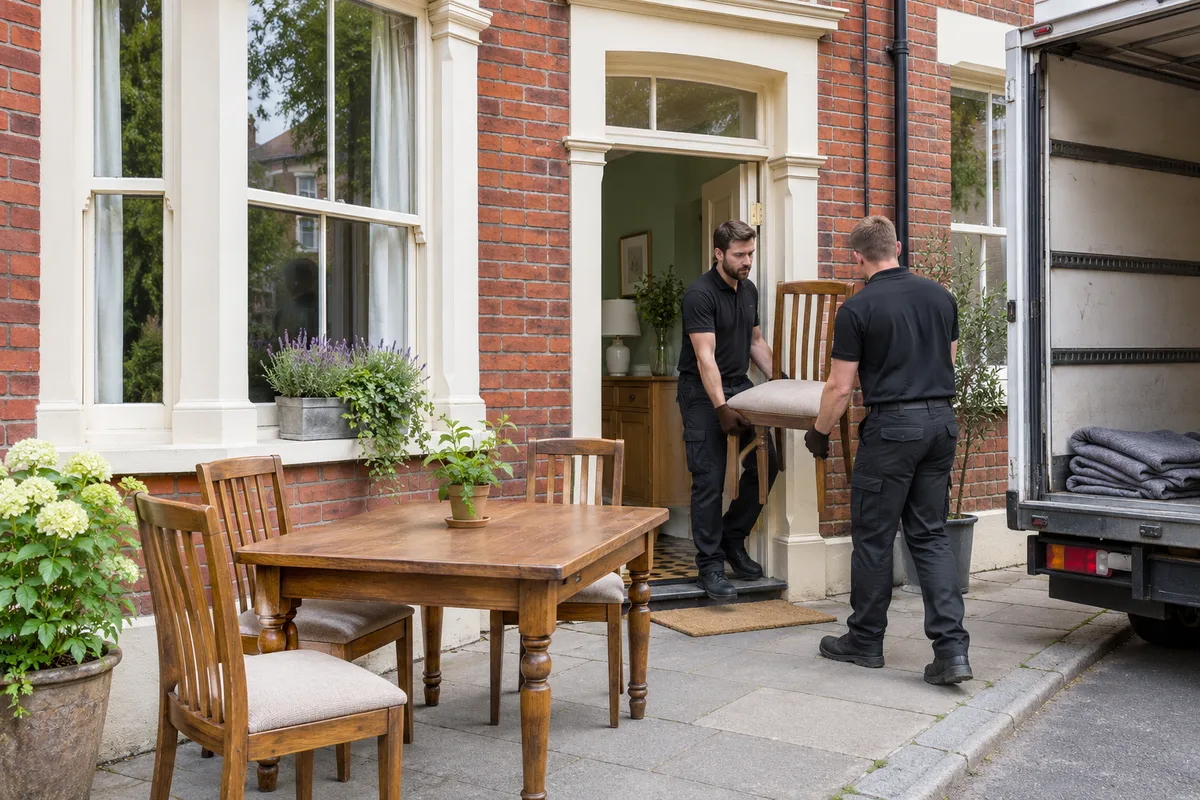
All generated photographs on this page are illustrative service scenes. They do not document jobs in Wandsworth.
Discuss your Wandsworth collection
Call +44 20 3404 3985 with the collection postcode, item list and property details. We will discuss the scope, available arrangements and quote before work begins.
Services for your Wandsworth enquiry
Furniture disposal · Rubbish collection · House and flat clearance