
LONDON & THE M25
Junk Removal
in West Harrow.
A front room can need a selective clearance before it becomes useful again. We organise West Harrow junk removal around the furniture and loose contents you want removed, while keeping retained fittings and belongings outside the instruction. The agreed items are carried, loaded and taken away for responsible onward handling.
- Carrying and loading included
- A clear quote before work begins
- Licensed and insured waste carrier

FROM ENQUIRY TO REMOVAL
West Harrow collections: the process we agree
01
Define the unwanted group
Separate furniture, contents and retained fittings.
02
Trace the authorised route
Describe room exit, porch and path.
03
Agree scope and quote
Include materials and extra work.
04
Review the front room
Check the list before onward handling.
Define the front-room collection
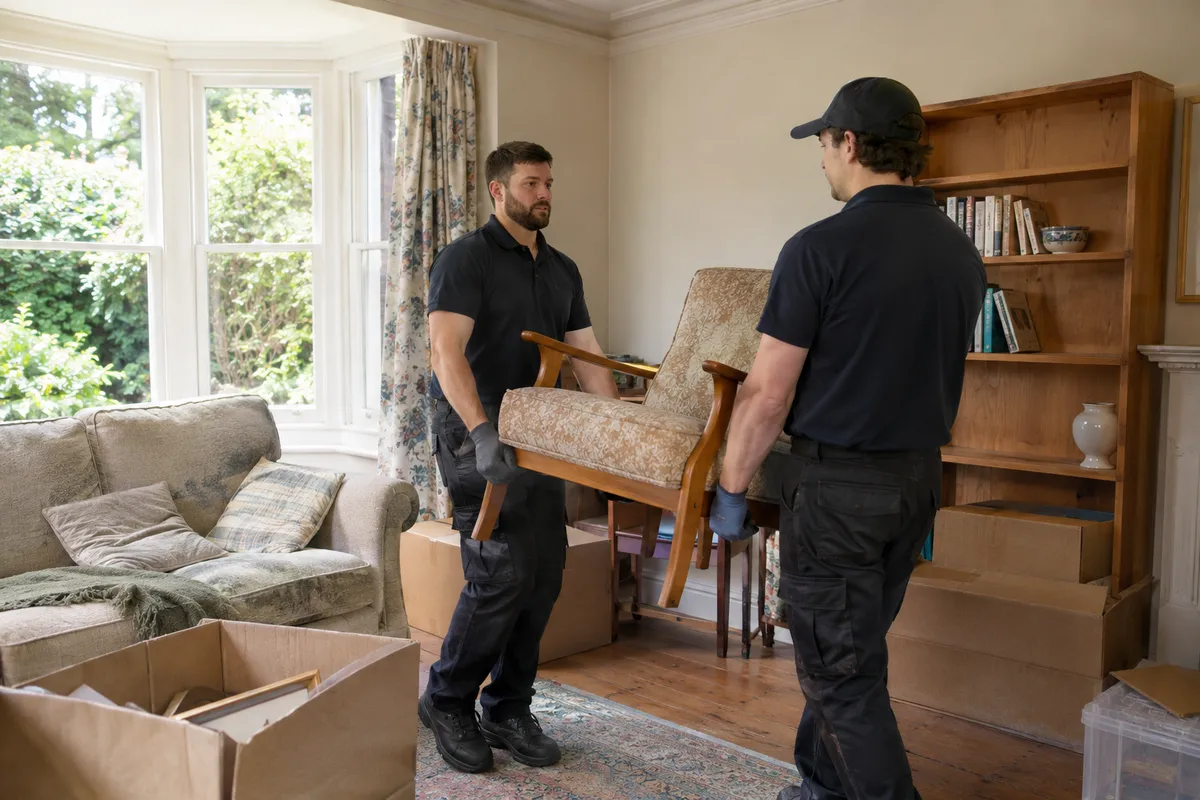
Tell Junk Please which furniture is preventing the room being used as intended. A bookcase, dining chairs and stored boxes may be unwanted while the sofa and a floor covering remain. List those distinctions explicitly rather than asking to clear the reception room. A room name is a useful way to organise an enquiry, but it does not establish the amount or permission to remove every object inside. Count substantial pieces individually and describe loose contents separately. If a bookcase stays and only its contents leave, say so. If the bookcase leaves, explain whether it is empty. The person attending should know which decisions have been made and have authority to confirm the list. We do not decide that old furniture has no value or that something beside an unwanted pile belongs in the collection automatically.
Distinguish freestanding furniture from the room itself
A front room may contain loose shelving alongside fitted cupboards, attached cabinets or fixed features. Tell us which items are freestanding and discuss any proposed dismantling explicitly. A request for furniture removal does not itself describe alteration to a building. Explain the construction, size and condition of substantial pieces, including loose glass or damaged joints. Do not begin taking apart something that would become unstable merely to prepare it for collection. Where furniture is already dismantled, identify the panels and fittings that are leaving and keep retained components separate. Floor coverings need their own description too: a rolled rug is different from material still fitted to the room. We should not infer a stripping-out task from the phrase complete clearance. A precise account gives the quote a clear basis and leaves the household’s later decorating decisions separate from our removal instruction.
Plan West Harrow access without a park shortcut
Harrow Council identifies access points for West Harrow Recreation Ground and explicitly warns against unauthorised access from gardens into its green spaces. For collection planning, do not assume that a nearby park provides a rear loading route to your home. Describe the actual authorised entrance and path instead. A frontage near an open space can still require all furniture to leave through the house. Give us the full postcode and explain the available loading position, gates and any shared access. We do not infer vehicle permission from a public footpath or a gap that happens to exist. The official recreation-ground information supplies the local reference. The property’s own entrance, relevant restrictions and permission for private space determine the practical collection discussion. If access is uncertain, raise that uncertainty before booking rather than presenting a shortcut as an agreed route.
- List loose furniture and contents separately
- Identify fixed units before discussing removal
- Describe porch turns and front-path steps
- Use only authorised property access
- Keep retained flooring and fittings explicit

| Group | Describe | Retain explicitly |
|---|---|---|
| Bookcase | Empty or containing belongings | Books and papers kept |
| Seating | Number and condition | Sofa or matching chairs |
| Fixed unit | Attachment and proposed work | Building fittings |
| Floor material | Loose or still fitted | Room covering staying |
Work through the porch and front path
Furniture in a ground-floor reception room can still have an awkward exit. Describe narrow doors, a porch, tight turns and steps to the pavement or driveway. Give dimensions for a substantial bookcase, table or sofa and explain whether it can separate. We need the route the team will actually use, not an assumption that ground-floor means a straightforward carry. If retained furniture limits the passage, tell us what space remains. Keep the route clear where practical without attempting an unsafe lift. Shared entrances may require someone present to provide access throughout the work. A possible loading space should be described with its authority and relevant restrictions rather than assumed from an empty position. The quote should reflect the distance and work between the contents and loading. If the items move to another room before the visit, update that location so the carrying arrangement remains accurate.
Separate stored contents from renovation leftovers
Reclaiming a room can expose boxes of belongings and material from earlier home projects. Describe books, crockery or other dense contents generally and give an approximate amount. Empty packaging should not be treated as equivalent to heavy boxes. Name mattresses and electrical equipment separately, even if they have simply been stored behind furniture. If timber, tiles or rubble are proposed for collection, identify those materials rather than calling everything household junk. Unknown containers and potentially hazardous substances need to be raised before booking so acceptance and any specialist requirement can be discussed. We do not assume every material in a room is accepted because the furniture is. Outdoor additions also need their own type, amount and location. A clear material mix supports an accurate quote and appropriate onward handling, while helping you decide which groups belong in the current visit.


| Material | Service | Useful detail |
|---|---|---|
| Room contents | House and flat clearance | Furniture and boxes |
| Project material | Builders clearance | Timber, tiles or rubble |
| Outdoor additions | Garden waste collection | Type and separate location |
| Work equipment | Office clearance | Ownership and electronics |

A fictional reception-room reset
Imagine a household wanting its front room available for everyday use again. The unwanted group includes an empty freestanding bookcase, four chairs and boxes of ordinary household contents. A fitted cupboard, sofa and rug remain. This is an illustrative planning example, not a completed West Harrow job. We would confirm the bookcase construction and route through the porch, then discuss the boxes separately. The fitted cupboard would stay outside the collection instruction. If a rolled carpet already removed from another room is added, its condition and amount need to be described explicitly. We would ask about the front path and loading position without assuming a route through nearby public space. The final quote could then reflect the settled load and carrying. The room’s future use provides context, but the authorised item list defines what our team takes away.
Agree the price before the room is rearranged
Our quote follows the amount, material mix, carrying requirements and additional work agreed. We do not invent a West Harrow reception-room tariff or assume that a ground-floor room creates a standard collection. Furniture dimensions, dense contents and the route all matter. Tell us about timing needs and ask about current availability rather than treating the enquiry as a reserved appointment. Before loading begins, confirm that the photographs and list still describe what is waiting. If a relative has taken the chairs or sorting has produced more bags, update us. Changes in access matter too, including an entrance that can no longer be used. The responsible person should understand the scope and price being agreed. A clear arrangement keeps our collection connected to the actual room contents, even when the wider household project is still changing around it.
| Point | Confirm | Why |
|---|---|---|
| Room | Furniture construction | Potential dismantling |
| Porch | Turns and opening | Bulky-item movement |
| Path | Steps and available width | Actual carrying |
| Loading | Authorised position | Workable arrangement |
See the current collection price guide, then confirm your complete quote with us. No separate West Harrow tariff is implied.
Check what has gone and what remains
After loading, review the specified furniture, components and loose groups against the list. Confirm that retained fittings and belongings remain as intended. A room need not be completely empty if the collection was selective. The waste leaves for responsible onward handling, with reuse and recycling considered where suitable to material and condition. We do not guarantee every item can be reused or state an unsupported local recycling percentage. Removal does not automatically include decorating preparation, repairs, carpet fitting or rearranging retained furniture. Discuss any separate requirement explicitly. If moving the bookcase reveals another unwanted group, describe it and agree any addition before it is loaded. A defined handover makes the result easy to assess and leaves the household with a clear starting point for the next stage of the reception-room project.

LOCAL COLLECTION AREA
Where we collect in West Harrow
The map marks West Harrow’s verified place location for orientation, not a depot or loading point. Give us the full postcode and actual property entrance. Public recreation-ground access should not be assumed to serve a private collection.
Nearby collection areas: North Harrow · Rayners Lane · Harrow
Our London and M25 coverage is described on the Areas We Cover page. The local information here concerns the collection enquiry; it does not create a separate neighbourhood branch.

Greater London reference outline: GLA / OS Open Data (OGL). Location: GeoNames UK gazetteer. This is an orientation map, not a service boundary or branch address.
COLLECTION QUESTIONS
West Harrow removal enquiries: questions answered
Can a fitted cupboard stay while loose furniture leaves?
Yes. Identify the fitted unit as retained and list the freestanding pieces being removed. A reception-room collection does not automatically include fixtures or alteration to the building.
Does ground-floor furniture need access details?
Yes. Porches, tight turns, steps and front paths can affect carrying even without stairs. Give substantial item dimensions and describe the route to the proposed loading position.
Can nearby park access be used as a shortcut?
Do not assume that public green space or garden access provides an authorised collection route. Describe the property’s available entrance and confirm any permission needed. We plan the visit around the actual lawful access.
Should a carpet be listed separately from furniture?
Yes. Explain whether it is already lifted and rolled or remains fitted, and give an approximate amount. Do not assume furniture removal includes stripping floor coverings. Discuss the actual proposed work explicitly.
Can boxes found behind a bookcase be added?
Describe their amount and general contents before adding them to the load. The quote follows the agreed collection, so newly discovered groups need discussion rather than automatic inclusion.
Will the room be decorated after collection?
Decorating, repairs and arranging retained furniture are separate requirements. Our agreed task is carrying, loading and taking away specified unwanted contents. Explain any additional work so the service endpoint is clear.
All generated photographs on this page are illustrative service scenes. They do not document jobs in West Harrow.
Discuss your West Harrow collection
Call +44 20 3404 3985 with the collection postcode, item list and property details. We will discuss the scope, available arrangements and quote before work begins.
Services for your West Harrow enquiry
Furniture disposal · Rubbish collection · House and flat clearance