
LONDON & THE M25
Junk Removal
in Yeading.
A garage utility corner can hold an old appliance, redundant storage and boxes from several household projects. We organise Yeading junk removal by identifying each group and the work needed before it can leave. We agree the materials, access and collection, then carry and load the specified contents for responsible onward handling.
- Carrying and loading included
- A clear quote before work begins
- Licensed and insured waste carrier

FROM ENQUIRY TO REMOVAL
Yeading collections: the process we agree
01
Identify the main appliance
Describe condition and preparation.
02
List storage additions
Separate panels, boxes and retained tools.
03
Agree access and quote
Explain the route and complete mix.
04
Review the utility corner
Check agreed groups before onward handling.
Start with the appliance and its condition
If an appliance is the reason for the enquiry, name it rather than describing a heavy item in the garage. Tell Junk Please what it is, where it stands and whether it remains connected. Work beyond carrying and loading needs explicit discussion. We should not assume a stored appliance is disconnected, nor that a collection request includes altering services. Explain any damage, loose parts or contents still inside. Keep belongings being retained out of the removal group. Other household electrical equipment should be named separately rather than hidden within the main appliance description. The garage’s size does not define the load. A specific starting item, with the additional groups identified, gives the enquiry a clearer scope and allows relevant handling and charges to be discussed before a visit is agreed.
Separate storage contents from the storage itself
A utility corner may contain shelving, cabinets and work surfaces alongside the appliance. State which units are unwanted and whether they are loose, dismantled or attached. Taking out fitted storage is different from collecting panels already removed. Discuss any proposed dismantling explicitly. Check drawers and cupboards for retained possessions and describe contents that are also leaving separately. We do not decide that everything on a shelf belongs in the load because the shelf is unwanted. If a unit stays while its contents leave, say so. Keep tools, household supplies and personal paperwork apart from the waste where practical. If several people use the garage, settle ownership and nominate someone who can confirm the list. A clear instruction prevents a small utility-space enquiry becoming an assumption that the entire garage or its fixtures should be cleared.
Yeading needs an authorised property route
Hillingdon Council provides a specific record for Yeading Brook Meadows among its local green spaces. It is a useful official reference for the locality, but nearby public land does not establish a route for a private garage collection. Give us the full postcode and actual entrance. Explain whether the garage faces a road, sits behind the home or uses a shared approach. We do not assume permission to cross neighbouring land or use a path because it appears direct on a map. Confirm who controls any private courtyard or managed access proposed for loading. The official Yeading Brook Meadows record supplies local context rather than loading authority. The available property route and relevant restrictions at the specific position need their own consideration. Raise uncertain access before the visit is agreed.
- Name the appliance and connection status
- Separate loose panels from fitted storage
- Describe boxes by contents as well as number
- Confirm gates and the full bulky-item route
- Keep retained tools and work surfaces explicit

| Group | Describe | Clarify |
|---|---|---|
| Appliance | Type, location and condition | Connection work remaining |
| Storage | Panels or assembled units | Loose versus fixed |
| Packaging | Amount and empty condition | Dense contents separate |
| Household boxes | General contents | Ownership and retained items |
Use the appliance position to explain the carry
A utility corner can leave very little room beside the appliance you want removed. Tell us whether doors can open, whether a retained shelf projects over it and whether the object can reach the garage doorway without another unit being disturbed. We are discussing the existing arrangement, not asking you to pull a heavy appliance out to prove it moves. Give the dimensions you know and show the narrowest part of the proposed exit. If the garage leads to a side gate, include the intervening turn and any step. This helps distinguish a straightforward doorway carry from a longer movement through several openings. Loose shelving panels stored in front of the appliance also need to be identified: are they part of our load, or will they be retained elsewhere? Their status affects the route as well as the inventory.
Explain what the utility storage has accumulated
Separate the appliance from the materials that have collected around it. Flattened cartons, loose shelf boards and boxes still full of household possessions are three useful descriptions. Say whether a container is empty before calling it packaging. If tiles or other dense project leftovers sit at the bottom of the pile, describe their amount independently; the visible cartons should not conceal them in the estimate. Small electrical devices deserve names of their own. Tins or bottles whose contents are uncertain should remain an explicit question in the enquiry, with any information already known supplied without opening something unsafe. This approach lets us discuss what can join the proposed collection. It also gives you a sensible sorting boundary: retained household supplies and tools belong outside the unwanted groups, even when they occupy the same shelf.


| Contents | Service | Focus |
|---|---|---|
| Household storage | House and flat clearance | Furniture and loose contents |
| Project leftovers | Builders clearance | Material and density |
| Outdoor additions | Garden waste collection | Cuttings versus soil |
| Work furniture | Office clearance | Equipment identified |

A fictional utility-corner collection
Imagine a household wanting access to garage storage again. The authorised load includes a disconnected old appliance, loose shelving panels, empty cartons and boxes of ordinary household contents. Tools and an attached work surface stay. This is an illustrative planning example, not a completed Yeading job. We would ask for the appliance type and condition, then distinguish the panels from the boxed contents. The retained work surface would be excluded explicitly. We would discuss the garage door, side gate and carrying distance to loading. If tiles from an earlier project are added, they need a separate material and amount description. The household could then confirm the final scope and price before carrying. The aim of recovering space helps organise decisions, while the specific authorised load defines the task our team removes.
Confirm preparation before agreeing the utility-corner price
The appliance description should still be true when the collection is arranged. If it remains connected, tell us exactly that; a price discussion for carrying a prepared item should not depend on an unspoken expectation that someone will disconnect it. Similarly, explain whether shelving has already been taken apart or is still fixed in place. The quote can then be discussed against the appliance, loose additions and actual carry. When another household member clears cartons or adds boxes after the photographs, send an updated account rather than treating the first image as permanent. Include the status of the gate and any agreed private loading position. The price should correspond to a settled utility-space task. A garage floor area or the phrase one appliance cannot communicate the additional material, preparation and route that may be involved.
| Point | Confirm | Purpose |
|---|---|---|
| Scope | Appliance and additions listed | Defined load |
| Preparation | Actual connection status | Agreed work |
| Access | Gate and path available | Real carrying |
| Handover | Retained fixtures excluded | Clear completion |
See the current collection price guide, then confirm your complete quote with us. No separate Yeading tariff is implied.
Review the appliance space and loose groups separately
Once the specified contents are loaded, check the original appliance position as well as the panel and box groups. A clear corner can make it easy to overlook a board placed elsewhere or a separate carton agreed for removal. The tools and attached work surface that were retained should remain outside this check. The collected materials then receive onward handling appropriate to their nature and condition, rather than an assumed single destination for everything from a garage. We do not equate removing an old appliance with reconnecting a replacement or rebuilding the storage around it. If that next task is needed, it requires its own clear discussion. The useful endpoint is specific: the named appliance and authorised loose contents are gone, and you can see which remaining part of the utility project belongs to the household or another contractor.

LOCAL COLLECTION AREA
Where we collect in Yeading
The map marks Yeading’s verified place position for orientation, not a depot or service boundary. Give the full postcode and actual garage entrance. Nearby meadows and public paths do not establish loading access to private premises.
Nearby collection areas: Hayes · Southall · Greenford
Our London and M25 coverage is described on the Areas We Cover page. The local information here concerns the collection enquiry; it does not create a separate neighbourhood branch.

Greater London reference outline: GLA / OS Open Data (OGL). Location: GeoNames UK gazetteer. This is an orientation map, not a service boundary or branch address.
COLLECTION QUESTIONS
Yeading removal enquiries: questions answered
What should I show around the old appliance?
Include the space beside and above it, not just its front. Describe retained shelving, the garage doorway and any turn to a side gate. There is no need to attempt a heavy move to prepare an enquiry.
Can I say an appliance is ready before it is disconnected?
Describe its present state accurately. Tell us about remaining connections and discuss the required work. The collection should not rely on an assumption that another person will finish preparation.
How do I distinguish empty cartons from storage boxes?
State which containers are empty and give general contents for those still filled. This prevents a packaging estimate from overlooking household belongings or dense project material.
Do boards blocking the appliance count automatically?
Explain whether they are unwanted, retained or already scheduled to move. They affect access, but their position does not itself authorise their disposal.
What if a few tiles are under the cardboard?
Name the tiles and provide a separate approximate amount. Their density is a distinct part of the enquiry even when the visible pile is mostly light packaging.
Will the new appliance be connected after collection?
Connection of a replacement is a separate task. The agreed removal should specify the old appliance and loose contents, with any additional requirement raised before the visit.
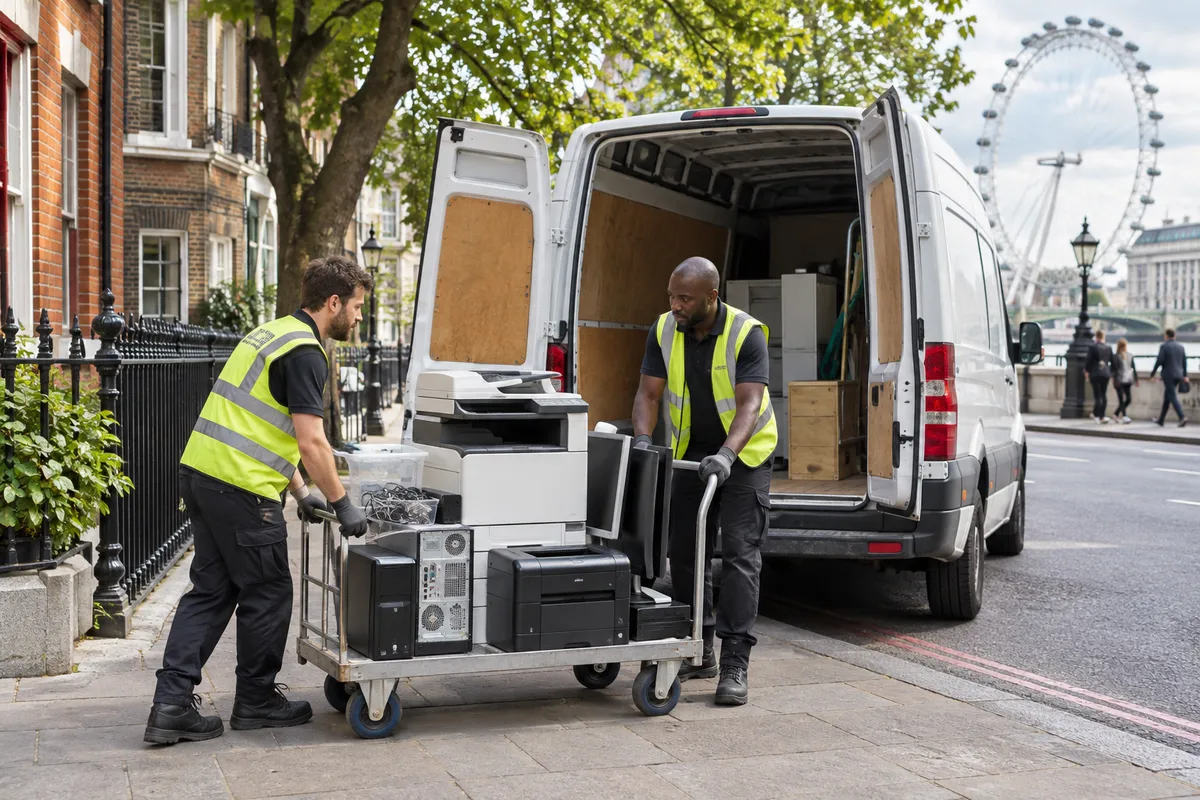
All generated photographs on this page are illustrative service scenes. They do not document jobs in Yeading.
Discuss your Yeading collection
Call +44 20 3404 3985 with the collection postcode, item list and property details. We will discuss the scope, available arrangements and quote before work begins.
Services for your Yeading enquiry
Furniture disposal · Rubbish collection · House and flat clearance