
LONDON & THE M25
Junk Removal
in Eastcote.
A garage can hold several different clearances at once: household furniture, stored packaging, garden equipment and material left from a project. We organise Eastcote junk removal by separating those groups in the enquiry, checking what should stay and agreeing the carrying and loading. That gives you a collection based on the real contents rather than a guess from the size of the garage.
- Carrying and loading included
- A clear quote before work begins
- Licensed and insured waste carrier

FROM ENQUIRY TO REMOVAL
Eastcote collections: the process we agree
01
Mark the keep group
Settle which tools and belongings remain.
02
Describe the material groups
Name furniture, appliances and dense leftovers.
03
Agree the route and price
Explain entrances and confirm the complete collection.
04
Check the cleared storage
Review the agreed load before responsible onward handling.

Reclaim storage by defining what is leaving
Start at the entrance and describe the groups you can actually see. A garage filled to the door may contain very little waste behind the first row, or it may have furniture and boxes stacked throughout. Tell Junk Please which description is closer and identify anything you cannot yet inspect. We need the unwanted contents distinguished from tools, bicycles and other belongings being kept. A garage clearance does not mean every object inside is automatically included. If you want only the rear shelving emptied, explain that boundary and describe the loose contents separately from the shelving itself. Someone who knows the property should be available to confirm decisions. Where several family members use the storage, agree ownership before the visit. We can help with the agreed carrying and loading, but deciding whether a box contains something valuable remains a task for its owner. An accurate list lets the enquiry progress towards a quote while keeping retained belongings out of the removal process.
Look behind the phrase mixed garage waste
Different materials need more than a single photograph from the doorway. Furniture and packaging occupy space differently from tiles, bricks or bags of soil. Name any dense material, describe approximately how much there is and state whether it is loose or contained. Explain whether timber is a dismantled cabinet, ordinary offcuts or part of a structure still fixed in place. Removing fitted or attached material is not something to assume from a general collection request. Appliances and electrical equipment should also be named, including anything left in storage after a kitchen change. If containers have unknown contents, say so before booking and do not mix them into bags of ordinary rubbish. Paints, chemicals and potentially hazardous substances need an explicit discussion of acceptance and any specialist requirement. The aim is not to produce an elaborate catalogue; it is to give enough information for us to understand the load. A few clear groups, with unusual or heavy items identified separately, are more useful than a broad description that hides the important differences.
Eastcote’s local context needs the full postcode
The official conservation material distinguishes Eastcote Village from Eastcote Park Estate, while Harrow’s Eastcote Village appraisal also refers to the neighbouring Hillingdon area. This is a useful reminder that a locality name does not answer every question about a property. We ask for the complete collection address and postcode rather than assuming a council boundary or building type from Eastcote alone. Explain whether the garage faces a public road, sits behind the house or is reached along a shared access. A postal address may not identify the entrance the team should use. Conservation information does not tell us whether a particular driveway is available, nor create a special rule for ordinary junk removal. We plan around the existing access and your authority to use it. For official local context, see Hillingdon Council’s conservation-area information. For the collection itself, the useful details remain practical: gates, surface, carrying distance and the possible loading position.
- Distinguish stored belongings from unwanted contents
- Identify appliances and dense project leftovers separately
- Explain whether shelving is loose or still fixed
- Describe rear access and any shared garage entrance
- Update the list after the final family sort

| Stored group | What to identify | What must remain clear |
|---|---|---|
| Furniture | Number, size and condition | Items being kept |
| Project leftovers | Tiles, timber, rubble or packaging | Heavy materials are named |
| Electrical equipment | Appliance type and present location | Connection or dismantling work is discussed |
| Garden additions | Cuttings, pots and furniture separately | Soil is not described as green waste |
Make the storage route part of the job
A rear garage can involve more carrying than a room beside the front door. Tell us whether the team can reach it directly, whether a side passage is available and whether anything restricts that passage. Measure the narrowest point if a bulky freezer, cabinet or workbench needs to pass through it. We should also know about steps, uneven surfaces and an entrance that cannot remain open without someone present. Do not move heavy objects into a precarious stack to make the area look ready. Instead, explain their current position and condition. If there is no clear route to inspect the contents, tell us that at enquiry stage. We can discuss the proposed work with that limitation understood. When a vehicle would need access to shared land or a managed compound, establish permission with the person responsible. An unlocked gate is not evidence that every vehicle can use the space. Carrying and loading should be planned around a route that is genuinely available for the agreed visit.
Keep the garden group identifiable
Clearing storage often reveals outdoor items that need a separate decision. A damaged bench, broken pots and green cuttings should not be described as the same material. State which objects are leaving and explain whether the pots still contain soil. For cuttings, give a useful estimate of the amount and tell us how they are gathered. If the garden route passes through the garage, that relationship matters to the order of work. We may need the storage contents moved before an outdoor group can be reached, so describe both locations rather than presenting them as independent kerbside piles. There is no need to assume that all garden materials can travel with every household load. We discuss the complete proposed mix and confirm what can be accepted. Likewise, do not include a shed structure when the request concerns only its contents. Dismantling and taking down attached material require a separate scope discussion. A clear outdoor list keeps the convenience of one enquiry without obscuring the actual collection.


| Contents | Service | Enquiry focus |
|---|---|---|
| Furniture and household boxes | House and flat clearance | What belongs in the removal group |
| Outdoor material | Garden waste collection | Material type and garden access |
| Project debris | Builders clearance | Density, amount and containment |
| Work equipment | Office clearance | Furniture versus electrical equipment |

An example built around a usable garage
Consider a household that wants enough garage space to store bicycles again. The unwanted group includes two old dining chairs, flattened packaging, an unplugged appliance and a dismantled shelving unit. A stack of tiles from an earlier project is discovered behind the chairs, while gardening tools are being retained. This is a fictional planning example, not a claim about work completed in Eastcote. We would separate the dense tiles from the bulky furniture and ask for the appliance to be identified. The household would confirm whether the shelving is already loose and whether its fixings or contents are included. We would then discuss the garage entrance and carrying route, including whether the appliance can pass the gate. If the owners decide to retain the tiles, that change should be reflected in the final description. The objective is a usable storage space, but our task is the defined removal. We do not assume permission to clear every remaining object merely because more floor space would be convenient.
A reliable quote reflects the settled load
The price discussion needs the whole collection, including material type, quantity, access and agreed additional work. A garage photograph can help, but it is not a substitute for naming an appliance or explaining heavy building materials. We use the current service price information and the actual enquiry rather than inventing an Eastcote tariff. Tell us about any deadline when asking about availability; an enquiry alone does not confirm a particular arrival time. Before work begins, make sure the contents and price match what is waiting. If another family member has added bags, or a neighbour has taken the chairs, update the description. Changes can affect the amount and composition of the load. Access changes matter too: a shared gate becoming unavailable may change the carrying route even when the waste is identical. Raising those details early allows a proper discussion of the arrangement. The useful outcome is a clear agreement about the work and collection, not an estimate based on a storage space that has changed since the photographs were taken.
| Location | Detail to give | Why we ask |
|---|---|---|
| Shared approach | Who can authorise access | Avoid assuming a right to load |
| Rear garage | Gate width and carrying route | Understand bulky-item movement |
| Inside storage | Anything hidden or inaccessible | Keep the scope honest |
| Loading position | Available space and restrictions | Discuss a workable arrangement |
See the current collection price guide, then confirm your complete quote with us. No separate Eastcote tariff is implied.
Close the collection against your original purpose
After the agreed contents have been loaded, check the garage and any outdoor group against the removal list. Confirm that retained equipment remains where intended and that no agreed pile has been overlooked behind another item. The waste then leaves for responsible onward handling, with reuse and recycling considered according to material and condition. We do not claim that everything from a mixed garage clearance has the same destination or that every item can be reused. Removal also does not automatically include sweeping, repairs, rebuilding shelves or preparing the space for a new use. Discuss any separate requirement rather than leaving it implicit in the phrase garage clearance. If the cleared space exposes further contents you want removed, identify them and agree how they are to be handled. Finishing with that distinction makes the result easier to assess: the unwanted materials described for the visit are gone, the items being kept remain, and any next stage of the storage project can proceed with a clear starting point.

LOCAL COLLECTION AREA
Where we collect in Eastcote
The map uses Eastcote’s OpenStreetMap suburb position for orientation. It does not identify a depot or define a collection boundary. Give us the complete postcode and actual garage or property entrance, especially where access differs from the postal address.
Nearby collection areas: Ruislip · Rayners Lane · West Ruislip
Our London and M25 coverage is described on the Areas We Cover page. The local information here concerns the collection enquiry; it does not create a separate neighbourhood branch.
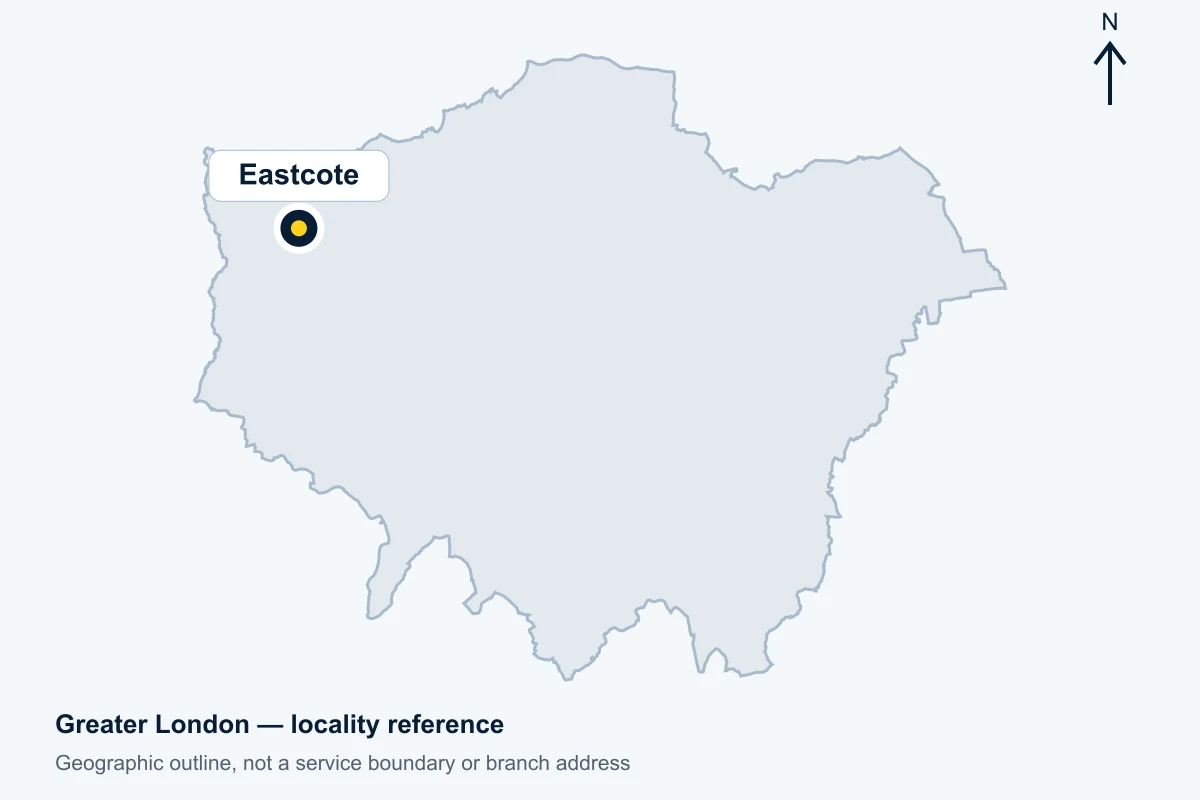
Greater London reference outline: GLA / OS Open Data (OGL). Location: OpenStreetMap Nominatim. This is an orientation map, not a service boundary or branch address.
COLLECTION QUESTIONS
Eastcote removal enquiries: questions answered
Can you quote when I cannot see the back of my garage?
Explain that limitation and show what is visible. We need to know that the inventory is incomplete rather than assume the front row describes everything. Update the contents as they become accessible, and confirm the final scope before loading begins.
Are old tiles included with ordinary stored household junk?
Describe tiles separately, including an approximate amount and whether they are loose or boxed. Dense project material affects the collection differently from furniture or packaging. We discuss the proposed mix and price rather than treating all garage contents as interchangeable.
Do I need to empty a shelving unit before it is removed?
Tell us whether both the shelving and its contents are leaving. Retained belongings should be separated before collection. Explain whether the unit is freestanding, dismantled or fixed to the building so that the actual work can be discussed.
What if the garage is accessed from a different road?
Provide the postal address and explain the actual entrance, including any gate or shared approach. A clear access description helps us discuss the carrying route and loading position. Confirm permission to use managed or shared land rather than relying on an open entrance.
Can soil-filled pots be grouped with garden cuttings?
List them separately and say whether the soil remains in the pots. Cuttings, soil and broken containers are different materials. We need the complete description to confirm acceptance and discuss the collection quote.
Will a garage clearance include organising everything I keep?
Our agreed task is to carry, load and remove the specified unwanted contents. Sorting ownership, rebuilding storage or organising retained tools should not be assumed to be included. Identify any additional requirement explicitly so that the proposed scope is clear.
All generated photographs on this page are illustrative service scenes. They do not document jobs in Eastcote.
Discuss your Eastcote collection
Call +44 20 3404 3985 with the collection postcode, item list and property details. We will discuss the scope, available arrangements and quote before work begins.
Services for your Eastcote enquiry
Furniture disposal · Rubbish collection · House and flat clearance