
LONDON & THE M25
Junk Removal
in Sutton.
We arrange Sutton collections around a clear description of the unwanted contents and the practical work needed to remove them. A flat above a business, a house with several rooms to clear and a commercial storeroom have different access questions. Give us the full postcode, item list and entrance details. We discuss carrying and loading the agreed items rather than assume everything is waiting at the road. The complete quote is confirmed before work starts, with any additional task or changed contents raised explicitly.
- Carrying and loading included
- A clear quote before work begins
- Licensed and insured waste carrier

THE CARRYING ROUTE
Planning the Sutton carrying and loading
01
Identify the premises
Give the postcode, property type and actual entrance.
02
Confirm authority and contents
List removable items and possessions staying.
03
Explain the practical route
Include stairs, stores and managed loading entry.
04
Agree scope and price
Confirm accepted materials, work and availability.
05
Carry and remove
We load the agreed contents for responsible handling.

Sutton town enquiries use the actual premises
This page concerns Sutton as a locality, rather than treating the whole London borough as one collection address. The council publishes a separate Sutton Town Centre conservation appraisal alongside studies for other local areas. That official distinction helps keep the enquiry precise. Tell us whether your load is in a town-centre flat, house, office or shop and identify the entrance that reaches it. The postal frontage might be different from the door serving an upper floor. Include entryphones, locked gates and any separate storage area. We need the complete postcode and practical approach, not only a nearby landmark. The collection is discussed around your building and contents without inventing a depot, fixed driving route or town-wide arrival time.
A flat collection begins inside the building
Explain which rooms contain the unwanted items and how they connect to the exit. For an upper floor, include stairs, lift suitability and any shared corridor. A lift’s existence alone does not establish that bulky furniture fits or may be moved that way under the building’s arrangements. We can discuss a limited load through domestic clearance, so you do not need to describe the whole flat as unwanted when most contents remain. Tell us about retained furniture and landlord appliances before the visit. Our team handles agreed carrying, which means moving bulky items into a communal hall is not required to begin the enquiry. An attending representative should know the removal list and be able to provide access to every included location.
ADDRESS & LOADING
Business contents need a separate authorised instruction
For a shop or office, distinguish unwanted business furniture, stock and equipment from landlord fixtures and retained possessions. A nominated contact should confirm what may leave. Our shop clearance and office clearance services can be discussed for defined contents rather than assumed to mean a complete strip-out. Tell us about an upper-floor store, basement or rear service entrance if used. List shelving and desks apart from monitors, printers and appliances. Any specialist data requirement needs explicit discussion; equipment collection does not automatically include a data destruction certificate. We also need to know who controls vehicle entry if the business uses a managed yard. Keeping authority, materials and access together makes the commercial enquiry a practical removal instruction.
- Identify Sutton locality with the full postcode and actual entrance
- Give managed loading-entry details before an appointment
- Describe storage-cupboard contents separately from flat furniture
- Keep business and landlord possessions distinct in the instruction
- Name electrical items and dense repair waste rather than only boxes

| Premises | Explain | What it establishes |
|---|---|---|
| Upper-floor flat | Entrance, floor and suitable route | Carrying from the actual rooms |
| Separate store | Contents, keyholder and exit | The location is explicitly included |
| Shop or office | Authorised list and retained fixtures | Business ownership is clear |
| Managed service area | Entry contact and arrangement | Loading access can be discussed |

Illustration: a flat refresh and a separately managed entrance
Imagine a Sutton occupier replacing a sofa and bed while clearing household boxes from a storage cupboard outside the flat. This is an illustrative enquiry, not a completed-job claim. We would ask whether the sofa is assembled, what floor the flat occupies and who can open the storage area. If the building’s loading entrance is controlled by a manager, that arrangement belongs in the discussion before an appointment. The cupboard boxes should have their contents described; old monitors are not ordinary paper cartons. A retained dining table remains outside the list even if it stands near the sofa. We can then discuss one complete load and its carrying work. If the occupier later adds repair rubble from another room, the material and amount need including before the original quote is relied on.
Furniture is assessed by size, condition and position
For furniture disposal, name the pieces and provide dimensions where a door or turn is close. Explain whether furniture is freestanding, fixed, already dismantled or damaged. A tall cabinet, deep sofa and glass table create different handling considerations. Loose panels, broken glass and unstable components should be identified. Requested dismantling needs agreement before the price, while removal of fitted joinery should not be assumed to be ordinary carrying. Check drawers and shelves for belongings staying at the property. If several people own furniture in the same room, clarify the authorised contents. We remove the agreed pieces rather than decide ownership by age or condition. The enquiry should describe the object as it stands and the whole route it must follow to the loading point.
| Item group | Useful information | Relevant service |
|---|---|---|
| Bulky furniture | Size, condition and assembled form | Furniture disposal |
| Household boxes | Actual contents and approximate quantity | Rubbish collection |
| Repair bags | Rubble, tiles, timber or plasterboard | Builders clearance |
| Equipment | Appliances and electronic items individually | Electrical collection |
A mixed load still needs a material breakdown
Name appliances and electronic equipment individually, explaining connected or freestanding condition for larger items. Collection does not automatically include plumbing or electrical work. For refurbishment waste, separate tiles, rubble, timber and plasterboard and state whether the material is loose or bagged. Dense debris differs from light packaging, even when similar bags are used. Garden contents should distinguish green cuttings from soil, paving and outdoor furniture. Tell us where each group stands and how it is reached. Unknown containers, chemicals and suspected hazardous material need discussion before booking. General rubbish collection should not be treated as acceptance of every substance nearby. We establish the proposed contents before removal so the complete quote and responsible onward handling reflect the actual load.


Sutton loading guidance is checked against the proposal
Sutton Council distinguishes active loading from parking and warns against obstruction and inappropriate use of suspended bays. We use that official guidance as context for discussing your actual collection position, without promise of a universal allowance. Tell us whether loading is proposed on a public road, private drive or managed service area. Include any barrier, booking arrangement or contact controlling entry. The council loading information is the official reference, with applicable signs and conditions at the address still important. An empty bay or residents permit does not settle every detail. We connect the loading proposal to the carrying from each room or store, then discuss a practical appointment. We do not invent routes, arrival times or street rules for a Sutton collection.
See the current collection price guide, then confirm your complete quote with us. No separate Sutton tariff is implied.
| Detail | Confirm before work | Avoid assuming |
|---|---|---|
| Full scope | Every included room and store | An unseen location is covered |
| Extra work | Dismantling or fitted-item request | All joinery work is included |
| Loading proposal | Actual signs and private-entry conditions | Any empty bay can be used |
| Appointment | Current availability and agreed contents | Coverage alone confirms immediate removal |
Agree the complete collection price and outcome
Our current price guide provides the published bands and relevant supplements. Ask for the complete quote for the amount, material mix, specific items and carrying work described. Requested additional tasks should be explicit, and later additions need review before loading. A supplement for an appliance is not necessarily the complete price of collecting it. We check availability for the proposed visit, including urgent requests, rather than confirm a slot from the postcode alone. Once the accepted load is agreed, our team carries and loads it for responsible removal. We seek reuse and recycling where possible without guaranteeing a destination for every object or attaching unsupported statistics to the job. The collection removes the defined unwanted contents; cleaning, repair and installation work should be raised separately rather than assumed from the word clearance.

LOCAL COLLECTION AREA
Where we collect in Sutton
Sutton is a Greater London locality in the London Borough of Sutton. The marker identifies the town for orientation, not a depot or an administrative-borough centroid. We discuss the exact postcode and collection entrance. Cheam, Carshalton and Wallington are nearby named areas; each enquiry still needs its own contents, access and availability confirmed.
Nearby collection areas: Cheam · Carshalton · Wallington
Our London and M25 coverage is described on the Areas We Cover page. The local information here concerns the collection enquiry; it does not create a separate neighbourhood branch.
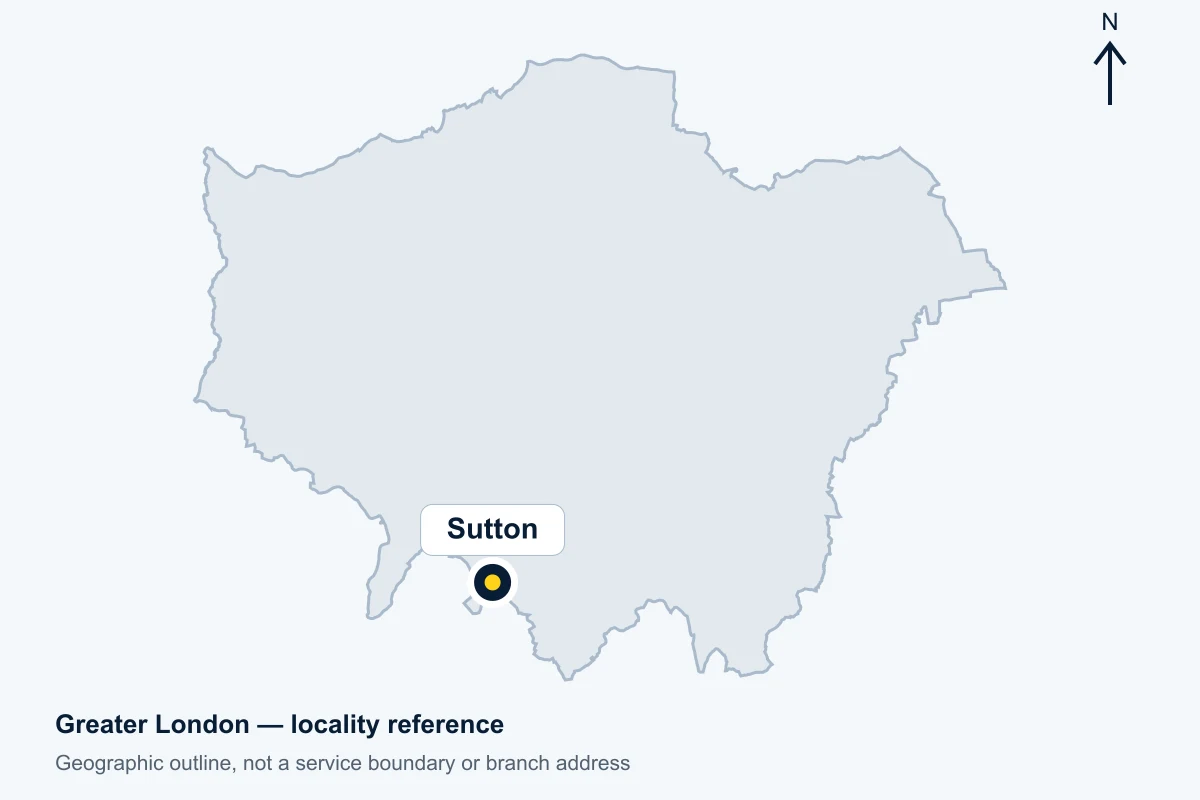
Greater London reference outline: GLA / OS Open Data (OGL). Location: GeoNames UK gazetteer. This is an orientation map, not a service boundary or branch address.
COLLECTION QUESTIONS
Sutton removal enquiries: questions answered
Is this Sutton page for the town or every address in the borough?
It identifies Sutton locality within Greater London. Give the full collection postcode and entrance details so the actual property can be discussed. Other named localities have their own coverage pages; a borough name alone does not establish the contents, access or appointment for a particular collection.
Can a Sutton flat collection include a cupboard outside the front door?
Include it explicitly with its contents and access arrangement. We need to know whether it is private, who provides the key and how it reaches the exit. The attending contact should identify the authorised load rather than assume every nearby storage space is included in a flat clearance.
Will you remove shop fittings as part of collecting old stock?
Describe any fixed fittings and the additional work requested. Removing agreed loose stock and furniture does not automatically establish a strip-out or joinery work. The business contact should distinguish landlord fixtures and retained items so the actual scope and full price can be discussed before booking.
Does council loading guidance mean any bay is available?
The actual position, signs and restrictions still need checking, along with any private management arrangement. Sutton’s guidance distinguishes loading from parking and warns against obstruction and inappropriate suspended-bay use. Tell us the specific proposal rather than assume a general allowance confirms access for every collection.
Can old monitors be collected with household furniture?
Name the monitors and other electrical items separately and explain their quantity and location. We can discuss the complete enquiry with the relevant material mix and handling. Collection does not itself promise specialist data treatment, so any information-security requirement should be raised explicitly before the appointment.
What if more repair bags are found after the initial quote?
Tell us the additional materials and approximate amount before the visit where possible. Rubble, tiles, timber and plasterboard should be distinguished from packaging. We review the agreed load and work before loading rather than assume an earlier furniture or household-rubbish quote includes every later addition.
All generated photographs on this page are illustrative service scenes. They do not document jobs in Sutton.
Discuss your Sutton collection
Call +44 20 3404 3985 with the collection postcode, item list and property details. We will discuss the scope, available arrangements and quote before work begins.
Services for your Sutton enquiry
Furniture disposal · Rubbish collection · House and flat clearance